
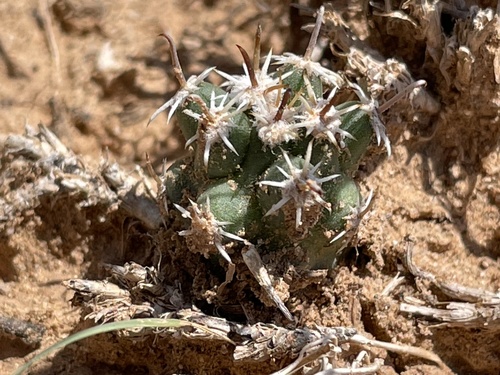


Clover'S Fishhook Cactus
sclerocactus cloverae
Clover's Fishhook Cactus (Sclerocactus cloverae) is a small, striking cactus native to the arid badlands and rocky clay hillsides of the southwestern United States, primarily northern New Mexico and southern Colorado. Named in honor of the pioneering American botanist Elzada Clover, this species is highly valued for its beautiful, funnel-shaped pink to purple blossoms and its intricate, defensive armor of hooked spines. It thrives in harsh, desolate environments where other plants struggle, playing a crucial role in the local desert ecosystem by providing food and nectar to native wildlife.
Habitat: Found in arid badlands, sagebrush communities, and rocky clay hillsides of northern New Mexico and southern Colorado.
This cactus features a solitary, egg-shaped to cylindrical stem that grows up to 25 cm tall, covered in prominent wavy ribs. Its most distinctive feature is its dense array of spines, including central spines that are sharply hooked like fishhooks, ranging in color from straw-yellow to dark reddish-brown. In late spring, vibrant pink-to-purple flowers bloom at the very top of the stem, opening fully under direct sunlight.
Category
PlantsRarity
Common
Danger
1/5 · Very low
Snaps
Be the first to snap!
It was named in honor of Elzada Clover, who was the first female botanist to successfully raft the Grand Canyon to collect plant specimens.
Its brilliant pink flowers open only under bright sunlight and close tightly on overcast days and at night to protect their reproductive organs.
The hooked spines are so strong and sharp that they were historically used as actual fishhooks by some indigenous groups.
The sharp, hooked central spines protect the plant from herbivores and help channel scarce rainwater directly toward the roots.
It opens its stomata only at night to absorb carbon dioxide, dramatically reducing water loss during hot desert days.
During extreme dry spells, the stem can shrink and pull slightly closer to the ground to minimize exposure and conserve moisture.
As a photoautotrophic plant, it produces its own energy using sunlight, carbon dioxide, water, and essential soil minerals.
Agapostemon texanus
Pollinates the bright flowers while collecting nectar and pollen.

Sylvilagus audubonii
Feeds on the succulent stems or fruits during severe drought conditions.
Glomus intraradices
Symbiotic root fungus that assists the cactus in absorbing scarce nutrients and moisture.
No trait badges are assigned for this object yet.
No aliases listed yet.
Collections for this object will appear here as more themes are added.
Danger
1/5 · Very low
No special safety notes yet.
Compare leaf arrangement, rosette shape, ribs, spines and flowers. Keep in mind that drought and strong sun can shift a plant's color and shape. Succulent Identifier: upload a photo and compare the visible details.
5-25 cm
0.1-1.5 kg
20-50 years
As a photoautotrophic plant, it produces its own energy using sunlight, carbon dioxide, water, and essential soil minerals.
Found in arid badlands, sagebrush communities, and rocky clay hillsides of northern New Mexico and southern Colorado.
Zoom in to split clusters and explore where this object has been snapped.
Recent snaps will appear here as new observations are added.
Take the discovery with you
Snap it with Snappit to identify it, learn what makes it special, and add the discovery to your collection.


















