

Common Rudd
scardinius erythrophthalmus
The Common Rudd, Scardinius erythrophthalmus, is a beautiful and adaptable freshwater fish belonging to the carp family. Known for its striking red fins and golden-bronze scales, it is a popular species among anglers and a common inhabitant of still and slow-moving waters across Europe and Asia. These fish typically form shoals, especially when young, providing both safety in numbers and efficiency in foraging. Their ability to thrive in a variety of aquatic environments, from clear lakes to weedy canals, highlights their resilience. Rudds are fascinating for their dietary flexibility and their distinctive upturned mouth, an adaptation perfectly suited for feeding on surface insects and aquatic vegetation.
Habitat: Found in still or slow-flowing waters such as lakes, ponds, canals, and slow-moving rivers, preferring areas with abundant aquatic vegetation.
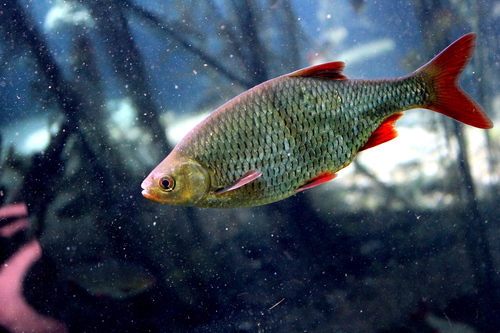
The Common Rudd is easily identified by its deep, compressed body and brilliant red or orange fins, particularly noticeable on the pectoral, pelvic, and anal fins, with the caudal fin often being a dusky red. Its scales are large and golden-bronze to silvery, reflecting light beautifully. The head is relatively small, with a distinctly upturned mouth, indicating its preference for surface feeding. Adults typically range from 15 to 30 cm in length, though larger specimens can be found.
Category
FishRarity
Common
Danger
1/5 · Very low
Snaps
Be the first to snap!
Despite being a small to medium-sized fish, they are a popular target for coarse anglers due to their striking appearance and willingness to take a variety of baits near the surface.
In some regions, the Common Rudd is considered an invasive species, particularly in North America and New Zealand, where it competes with native fish for resources and can alter aquatic ecosystems.
The Common Rudd is often mistakenly identified as the Common Roach due to their similar appearance, but the rudd's more upturned mouth and redder fins are key distinguishing features.
Their vibrant red fins develop more intensely in clear, healthy waters, making them a good indicator of water quality.
The Common Rudd possesses a uniquely upturned mouth, an adaptation perfectly suited for scooping insects and other food items from the water surface or just below it. This allows it to exploit a food source often unavailable to bottom-feeding fish.
This species can tolerate a wide range of water conditions, including low oxygen levels and slight brackishness. This adaptability allows them to colonize and thrive in diverse and sometimes less-than-ideal aquatic environments.
Rudds are known to readily hybridize with other cyprinid species, particularly the Common Bream (Abramis brama) and Common Roach (Rutilus rutilus). This ability can sometimes lead to challenges in species identification and ecological interactions.
The Common Rudd has a varied diet, consuming both plant matter and small aquatic invertebrates. They primarily feed near the surface and in the water column.
Age differences: Younger rudds primarily consume zooplankton and small invertebrates, while older and larger fish incorporate more aquatic vegetation and larger insect larvae into their diet.

Esox lucius
A significant predator of Common Rudd, especially larger individuals.
Rutilus rutilus
Known to hybridize with Common Rudd, creating fertile offspring and sometimes causing identification confusion.
Nymphaea alba
Provides habitat, shelter, and a primary food source for Common Rudd, especially larger fish.
Alcedo atthis
Juvenile Rudds are a food source for various fish-eating birds.
No trait badges are assigned for this object yet.
No aliases listed yet.
Collections for this object will appear here as more themes are added.
Danger
1/5 · Very low
No special safety notes yet.
Look at body shape, where the fins sit and their outline, mouth position, stripes and spots. Young fish and breeding adults can wear different patterns, and aquarium color varieties can look nothing like wild fish. Fish Identifier: upload a photo and compare the visible details.
15-45 cm
0.1-2.5 kg
5-10 years
15 km/h
The Common Rudd has a varied diet, consuming both plant matter and small aquatic invertebrates. They primarily feed near the surface and in the water column.
Found in still or slow-flowing waters such as lakes, ponds, canals, and slow-moving rivers, preferring areas with abundant aquatic vegetation.
Foraging
Zoom in to split clusters and explore where this object has been snapped.
Recent snaps will appear here as new observations are added.
Take the discovery with you
Snap it with Snappit to identify it, learn what makes it special, and add the discovery to your collection.