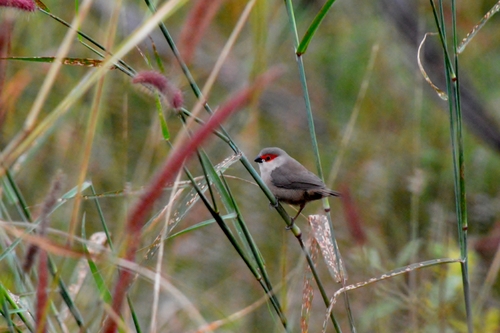


Common Waxbill
estrilda astrild
The Common Waxbill is a lively and highly sociable small finch native to sub-Saharan Africa. Renowned for its distinctive red 'bandit mask' across its eyes, this energetic bird is a delightful sight as it moves through tall grasses in fast, chattering flocks. Though tiny in stature, its remarkable adaptability has allowed it to thrive not only in its native range but also in various introduced regions across the globe, from tropical islands to southern Europe. Characterized by constant activity and sharp, rhythmic calls, the Common Waxbill forms strong social bonds, often seen preening flock mates and huddling together. Whether foraging diligently on the ground or clinging nimbly to grass stems to reach seed heads, this charismatic bird is a favorite among birdwatchers and a vibrant contributor to its grassland ecosystems.
Habitat: Found in tall grasslands and marshy reedbeds, often foraging among thick vegetation near water sources.
The Common Waxbill is a tiny bird, measuring about 11 to 13 cm in length, with a plump, rounded body. Its plumage is primarily greyish-brown with fine, dark transverse barring that gives it a beautifully textured appearance. The most striking visual features are its bright red, sealing-wax-like bill and a bold crimson stripe across its eyes, resembling a mask. Additionally, adults typically have a reddish flush down the center of their belly, which is more prominent in males. Juveniles lack the vivid red facial markings and have a black bill until they mature.
Category
BirdsRarity
Common
Danger
1/5 · Very low
Snaps
Be the first to snap!
Common Waxbills have been so successful as an introduced species that they now have wild, self-sustaining populations on remote islands like Saint Helena, Bermuda, and Hawaii.
The name 'waxbill' comes from their bright red beak, which looks exactly as if it has been dipped in traditional red sealing wax.
To protect their young, they often build a 'dummy' nest on top of their real nest; the male sleeps in the dummy nest to trick predators into thinking it's the only one.
When raising chicks, adults will perform acrobatic aerial maneuvers to catch swarming termites mid-air, ensuring a high-protein meal for their offspring.
It can expertly cling to thin grass stems, often turning entirely upside down, to extract seeds directly from the seed heads before they fall.
They fly in tight, fast-moving flocks, communicating with sharp, continuous 'tsep' calls to maintain formation and alert the group to potential predators.
Pairs build a specialized 'cock nest' atop their main enclosed breeding nest, which serves both as a roost for the male and as a dummy nest to confuse predators.
Primarily feeds on small grass seeds, either picked from the ground or stripped directly from seed heads, supplementing with insects during the breeding season.
Age differences: Chicks are fed a diet significantly richer in insects to provide the protein needed for rapid growth, while mature adults consume predominantly seeds.
Vidua macroura
Pin-tailed Whydahs lay their eggs in Common Waxbill nests, leaving the waxbills to unknowingly raise the whydah chicks.

Megathyrsus maximus
Common Waxbills heavily rely on the seeds of Guinea grass as a staple food source in both native and introduced ranges.

Falco biarmicus
Lanner Falcons and other fast aerial predators occasionally hunt small flocking birds like the Common Waxbill in open African habitats.
No trait badges are assigned for this object yet.
No aliases listed yet.
Collections for this object will appear here as more themes are added.
Danger
1/5 · Very low
No special safety notes yet.
Compare the silhouette, bill shape, tail length, wing bars and markings around the eyes. The same small brown bird at your feeder can look quite different in breeding plumage, winter plumage or its first year. Bird Identifier: upload a photo and compare the visible details.
11-13 cm
12-14 cm
0.007-0.01 kg
4-8 years
Primarily feeds on small grass seeds, either picked from the ground or stripped directly from seed heads, supplementing with insects during the breeding season.
Found in tall grasslands and marshy reedbeds, often foraging among thick vegetation near water sources.
Foraging
Zoom in to split clusters and explore where this object has been snapped.
Recent snaps will appear here as new observations are added.

Hawaii, US
You might spot Red-Crested Cardinal and Zebra Dove.
View guide →

Hawaii, US
You might spot Red-Crested Cardinal and Zebra Dove.
View guide →

Hawaii, US
You might spot Red-Crested Cardinal and Zebra Dove.
View guide →

Hawaii, US
You might spot Zebra Dove and Red-Crested Cardinal.
View guide →

Hawaii, US
You might spot Red-Crested Cardinal and Zebra Dove.
View guide →
Take the discovery with you
Snap it with Snappit to identify it, learn what makes it special, and add the discovery to your collection.