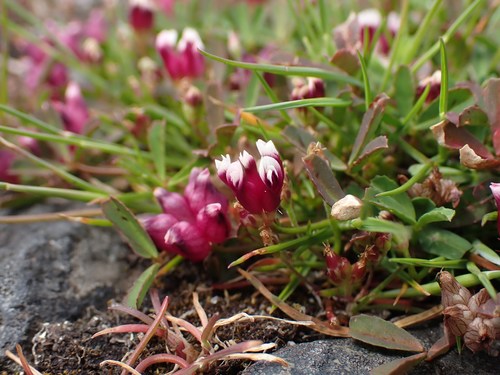


Cowbag Clover
trifolium depauperatum
Cowbag Clover (Trifolium depauperatum), also known as balloon clover, is a charming and distinctive annual wildflower native to western North America and temperate South America. Belonging to the pea family (Fabaceae), this low-growing plant thrives in open, often moist environments such as grassy slopes, vernal pools, and chaparral. Despite its delicate appearance, it is remarkably hardy, adapting well to nutrient-poor soils. What makes this clover truly unique is its seed heads, which inflate as they mature, resembling miniature translucent balloons or, colloquially, cow bags. This evolutionary trait plays a vital role in seed dispersal and survival, making it a fascinating find for plant enthusiasts exploring coastal scrub and grassland trails.
Habitat: Found in open, grassy areas, coastal scrub, chaparral, and near vernal pools across western North America.
This small, hairless annual typically reaches 10 to 30 centimeters in height, with stems that lay prostrate or ascend slightly. Its leaves are classic trifoliate (three-parted), with wedge-shaped leaflets that are green and sometimes feature subtle white or purple markings. The most striking feature is the flower head, measuring 1 to 2 centimeters wide, which features small, pinkish-purple to white pea-like flowers. As the flowers fade, the calyx of each individual flower inflates dramatically, forming a clustered, papery, balloon-like structure that transitions from pink-tinged green to a dry, straw-colored brown.
Category
PlantsRarity
Common
Danger
1/5 · Very low
Snaps
1
The common name 'Cowbag Clover' refers to the appearance of the inflated seed pods, which can look like tiny cow udders when clustered together.
This species exhibits an unusual 'disjunct' distribution, being native to western North America as well as parts of temperate South America, likely due to migratory birds carrying seeds.
Unlike many common lawn clovers, Cowbag Clover is a native wildflower of the western United States and plays a crucial role in maintaining native grassland biodiversity.
The calyces inflate into lightweight, air-filled balloon structures that shield the seeds and allow them to be easily dispersed by wind or water.
Forming a symbiotic relationship with soil bacteria (Rhizobia), this plant converts atmospheric nitrogen into a usable form, enriching the surrounding soil.
As an annual species, it completes its entire life cycle rapidly during the damp spring months, setting seed and dying back before the harsh summer drought begins.
Like most plants, Cowbag Clover produces its own food through photosynthesis, utilizing sunlight, water, and carbon dioxide.
Apis mellifera
The Western Honey Bee visits the flowers of the Cowbag Clover for nectar, acting as a key pollinator.
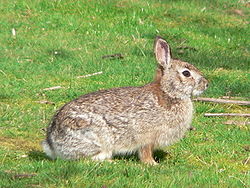
Sylvilagus bachmani
The Brush Rabbit grazes on the nutritious foliage of the clover in coastal scrub habitats.
Rhizobium leguminosarum
Rhizobium leguminosarum bacteria colonize the root nodules, exchanging fixed nitrogen for plant-produced sugars.
No trait badges are assigned for this object yet.
No aliases listed yet.
Collections for this object will appear here as more themes are added.
Danger
1/5 · Very low
No special safety notes yet.
Start with the whole plant, then compare leaf arrangement, leaf edges, stems and any flowers or fruit. Opposite leaves grow in pairs; alternate leaves come one at a time along the stem. These details tell you far more together than a single green leaf does. Plant Identifier: upload a photo and compare the visible details.
10-30 cm
0.001-0.02 kg
1 years
Like most plants, Cowbag Clover produces its own food through photosynthesis, utilizing sunlight, water, and carbon dioxide.
Found in open, grassy areas, coastal scrub, chaparral, and near vernal pools across western North America.
Zoom in to split clusters and explore where this object has been snapped.
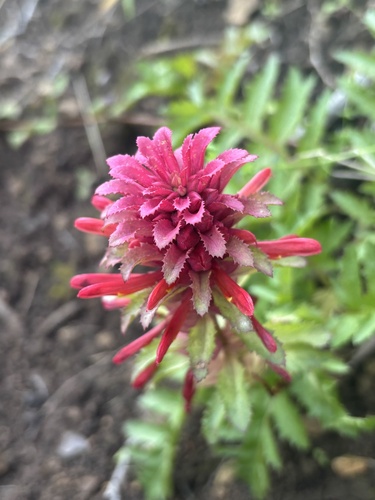
California, US
You might spot Warrior's Plume, Western Leatherwood, and White Globe Lily.
View guide →
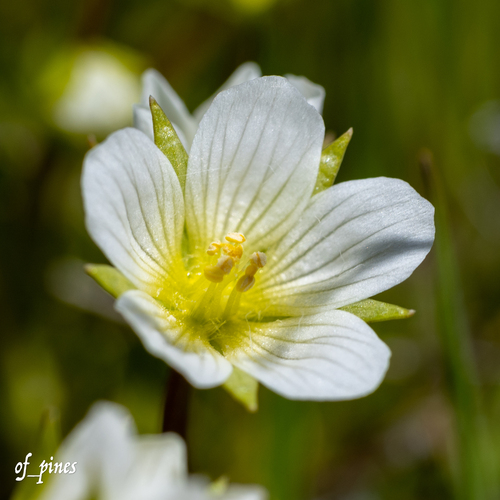
Oregon, US
You might spot Woolly Meadowfoam and California Goldfields.
View guide →
Take the discovery with you
Snap it with Snappit to identify it, learn what makes it special, and add the discovery to your collection.