
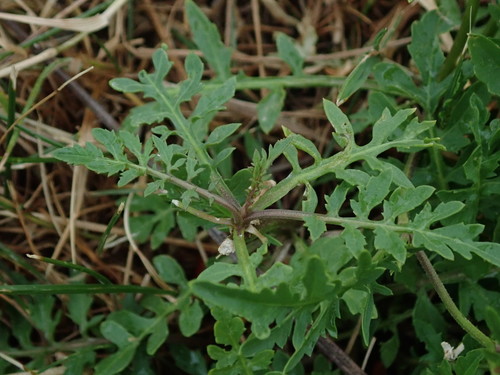


Creeping Yellowcress
rorippa sylvestris
Creeping Yellowcress (Rorippa sylvestris) is a highly resilient and vibrant perennial herb belonging to the mustard family. Native to Europe and Asia, it has successfully naturalized across North America, thriving particularly in damp, disturbed grounds. What makes this plant truly fascinating is its incredible tenacity; it spreads aggressively via a dense network of underground creeping roots (rhizomes). While gardeners often view it as a persistent weed, it plays a role in stabilizing wet soils along riverbanks and provides a nectar source for early-season pollinators. Its ability to colonize challenging environments showcases the remarkable adaptability of the Brassicaceae family.
Habitat: Typically found in damp, low-lying areas such as riverbanks, wet meadows, ditches, and cultivated gardens with moist soils.
This low-growing perennial typically reaches heights of 20 to 60 centimeters, featuring bright yellow flowers that bloom in small clusters at the ends of its branched stems. Each tiny flower is about 5 to 8 millimeters wide, displaying four distinct petals arranged in a cross shape, characteristic of the mustard family. Its leaves are deeply pinnately divided into narrow, sharply toothed lobes, giving the foliage a delicate, feathery appearance. Following fertilization, it produces slender, upward-pointing seed pods (siliques) that measure up to 15 millimeters in length.
Category
PlantsRarity
Common
Danger
1/5 · Very low
Snaps
Be the first to snap!
Despite being classified as a weed, its peppery leaves are technically edible, though they are rarely harvested due to their bitter taste and tendency to absorb soil contaminants.
Even tiny root fragments as small as one centimeter left in the soil can regenerate into an entirely new plant.
It belongs to the mustard family, sharing its lineage with popular agricultural crops like broccoli, cabbage, and horseradish.
Can rapidly regrow from extremely small rhizome fragments, making it exceptionally resilient to physical weeding and tilling.
Possesses specialized root adaptations that allow it to survive and photosynthesize in waterlogged, anaerobic soils where other plants drown.
Releases chemical compounds into the surrounding soil that can suppress the germination and growth of neighboring plant competitors.
As a photoautotrophic plant, Creeping Yellowcress produces its own energy using chlorophyll to capture sunlight, combining it with carbon dioxide and water.
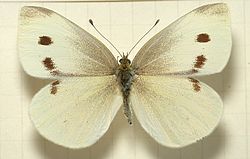
Pieris rapae
The larvae of the Cabbage White butterfly feed on the leaves of the Creeping Yellowcress.
Apis mellifera
Honeybees visit the bright yellow flowers to collect nectar and pollen, acting as key pollinators.

Cirsium arvense
Competes directly with other aggressive pasture plants like Creeping Thistle for soil space and nutrients.
No trait badges are assigned for this object yet.
No aliases listed yet.
Collections for this object will appear here as more themes are added.
Danger
1/5 · Very low
No special safety notes yet.
Start with the whole plant, then compare leaf arrangement, leaf edges, stems and any flowers or fruit. Opposite leaves grow in pairs; alternate leaves come one at a time along the stem. These details tell you far more together than a single green leaf does. Plant Identifier: upload a photo and compare the visible details.
20+ cm
2+ years
As a photoautotrophic plant, Creeping Yellowcress produces its own energy using chlorophyll to capture sunlight, combining it with carbon dioxide and water.
Typically found in damp, low-lying areas such as riverbanks, wet meadows, ditches, and cultivated gardens with moist soils.
Zoom in to split clusters and explore where this object has been snapped.
Recent snaps will appear here as new observations are added.

Illinois, US
You might spot Cliff Swallow, Baldcypress, and Indian Heliotrope.
View guide →
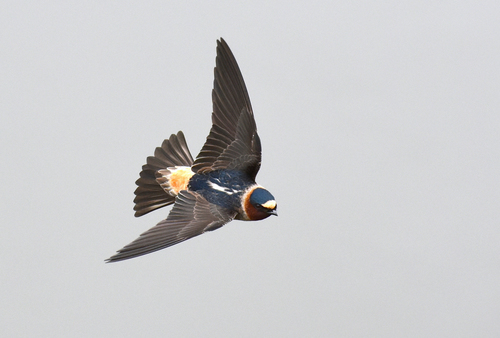
Illinois, US
You might spot Cliff Swallow, Baldcypress, and Indian Heliotrope.
View guide →
Take the discovery with you
Snap it with Snappit to identify it, learn what makes it special, and add the discovery to your collection.

















