





creeping thistle
Cirsium arvense
Creeping thistle is a tall plant with spiky purple flowers. It grows in fields and gardens, and its fluffy seeds can float in the wind, spreading far and wide!
Habitat: Grasslands
The creeping thistle has spiny, lance-shaped leaves that grow along its ribbed stem. Its vibrant purple flower heads are small, fuzzy, and typically clustered at the stem's top. Unlike some thistles, its flower heads are usually smaller and lack large spiny bracts.
Category
PlantsRarity
Common
Danger
2/5 · Low
Snaps
43
Each tiny purple flower head can release hundreds of fluffy seeds carried far by the wind!
Its roots can dive over 6 feet deep, making it incredibly hard to remove from the soil!
While a weed to farmers, many pollinators, like bees and butterflies, absolutely love its nectar!
Young creeping thistle stems, when properly prepared, can actually be cooked and eaten!
Creeping thistle can spread widely with deep, creeping roots (rhizomes) that help it find water and nutrients, making it very resilient.
Creeping thistle has sharp spines on its leaves and stems that protect it from hungry animals wanting to take a bite.
Creeping thistle produces numerous lightweight, fluffy seeds that can float far on the wind, colonizing new areas easily.
Apis mellifera
Collects nectar and pollen from flowers.

Vanessa cardui
Larvae feed on thistle leaves.
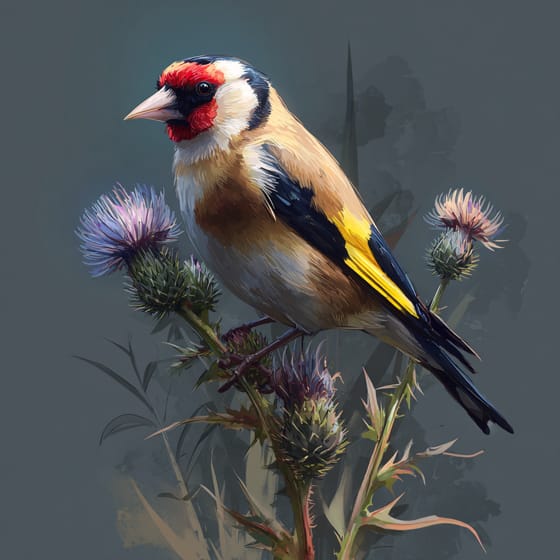
Carduelis carduelis
Feeds on the seeds from the flower heads.
Uroleucon cirsii
Sucks sap from stems and leaves.
Flowering plants are any plants that produce flowers as part of their reproductive cycle.
Biennial plants complete their life cycle over two growing seasons, typically forming foliage in the first year and flowering/seeding in the second.
Colorful describes organisms or objects displaying a wide range of bright and distinct colors.
Grassland habitats are terrestrial biomes dominated by grasses and herbaceous plants, supporting a variety of grazing animals.

Describes plants that are particularly attractive and beneficial to a wide range of pollinating organisms.

Rapid growing plants exhibit accelerated growth rates, quickly increasing in size and biomass within a short period.

Possessing sharp, pointed projections or spines on the body or surface.

Invasive species are non-native organisms that cause harm to the environment, economy, or human health.
No aliases listed yet.
Danger
2/5 · Low
Be careful of the sharp thorns on the leaves and stems.
The easiest way to identify creeping thistle is to use the Snappit nature identifier app.
30-150 cm
1-2 cm
Summer
Yes
Mild
Perennial
Insect
Zoom in to split clusters and explore where this object has been snapped.

New Jersey, US
You might spot Garlic Mustard, Sensitive Fern, and Common Mugwort.
View guide →

Ohio, US
You might spot Eastern Fox Squirrel and Spotted Lanternfly.
View guide →

Pennsylvania, US
You might spot Mountain Laurel, Ghost Pipe, and Sweetfern.
View guide →

Iowa, US
You might spot Common Eastern Bumble Bee and Eastern Cottontail.
View guide →

Iowa, US
You might spot House Sparrow and Common Eastern Bumble Bee.
View guide →

Pennsylvania, US
You might spot Tree-Of-Heaven, Spotted Lanternfly, and American Tuliptree.
View guide →
Take the discovery with you
Snap it with Snappit to identify it, learn what makes it special, and add the discovery to your collection.








.jpg&width=800)


_001.jpg&width=800)




