

Crimson Rosella
platycercus elegans
The Crimson Rosella is one of Australia's most beloved and visually striking parrots. Found throughout the wet forests, woodlands, and gardens of eastern and southeastern Australia, this medium-sized parrot captivates birdwatchers with its bold coloration and expressive, piping calls. They are highly social birds, often seen in pairs or small family groups foraging among the canopy or on the ground. Beyond their beauty, Crimson Rosellas play a crucial ecological role as seed dispersers and occasional pollinators. They have adapted remarkably well to human-altered landscapes, often visiting suburban gardens, parks, and feeding stations, making them a delightful and common encounter for nature lovers. Their intelligence, playful antics, and complex vocalizations make them a signature species of the Australian bush.
Habitat: Inhabits wet and dry sclerophyll forests, temperate rainforests, coastal woodlands, and suburban parks across eastern and southeastern Australia.
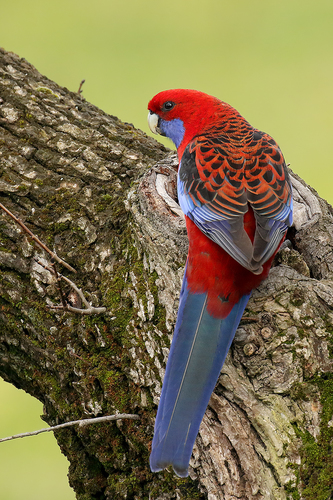
Adult Crimson Rosellas boast a stunning, bright crimson-red body contrasting sharply with royal blue patches on their cheeks, wing edges, and long tail feathers. The feathers on their back and shoulders are black, edged with bright red, giving them a distinct scalloped appearance. They possess a pale grey-horn colored bill and dark brown eyes. Juveniles look remarkably different, featuring a predominantly olive-green plumage with only patches of red on their chest and crown, which gradually transforms into the vibrant adult crimson over their first two years.
Category
BirdsRarity
Common
Danger
1/5 · Very low
Snaps
Be the first to snap!
Juvenile Crimson Rosellas look so different from adults, with their olive-green plumage, that early European settlers initially mistook them for an entirely different species.
They exhibit a strong preference for nesting in deep hollows of mature eucalyptus trees, which makes them highly dependent on old-growth forests.
To deter predators from their nest, brooding females will produce a loud, snake-like hissing sound from inside the dark tree hollow.
With two toes facing forward and two facing backward, they can grasp and manipulate food items with incredible dexterity, rotating seeds or fruits with one foot while feeding.
They possess a wide array of whistles, screeching alarm calls, and metallic piping notes, allowing them to communicate over long distances in dense forest canopies.
Juveniles feature olive-green feathers that blend seamlessly into the leafy forest canopy, protecting them from predators until they mature and gain their bright crimson adult plumage.
Feeds primarily on seeds of eucalypts, grasses, and shrubs, supplemented by native fruits, berries, nectar, and occasional insects.
Age differences: Juveniles consume a higher ratio of protein-rich insects and larvae to support rapid development before transitioning to a seed-dominant adult diet.

Trichoglossus moluccanus
Competes directly for vital nesting hollows in mature eucalyptus trees.
Acacia pycnantha
Feeds on the seeds and flowers, acting as a seed predator and occasional seed disperser.

Falco peregrinus
Preys upon fledglings and adult rosellas, especially in open woodland areas.
No trait badges are assigned for this object yet.
No aliases listed yet.
Collections for this object will appear here as more themes are added.
Danger
1/5 · Very low
No special safety notes yet.
Compare the silhouette, bill shape, tail length, wing bars and markings around the eyes. The same small brown bird at your feeder can look quite different in breeding plumage, winter plumage or its first year. Bird Identifier: upload a photo and compare the visible details.
32+ cm
44+ cm
0.11+ kg
10+ years
50 km/h
Feeds primarily on seeds of eucalypts, grasses, and shrubs, supplemented by native fruits, berries, nectar, and occasional insects.
Inhabits wet and dry sclerophyll forests, temperate rainforests, coastal woodlands, and suburban parks across eastern and southeastern Australia.
Zoom in to split clusters and explore where this object has been snapped.
Recent snaps will appear here as new observations are added.
Take the discovery with you
Snap it with Snappit to identify it, learn what makes it special, and add the discovery to your collection.