
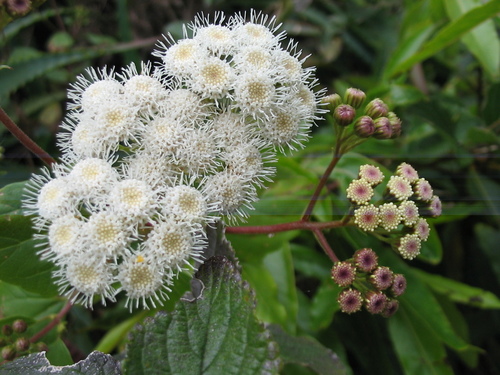


Crofton Weed
ageratina adenophora
Crofton Weed (Ageratina adenophora), also known as Mexican devil, is a highly resilient, fast-growing perennial shrub native to Mexico. Despite its delicate appearance with soft clusters of white flowers, this plant is recognized globally as an extremely aggressive invasive species. It thrives in disturbed soils, damp hillsides, forest edges, and riverbanks across Australia, South Africa, Asia, and the Pacific. Its exceptional ability to outcompete native flora makes it a major concern for conservationists and agriculturalists alike. What makes Crofton Weed particularly formidable is its ecological strategy; it actively alters the surrounding soil chemistry to suppress competing vegetation, establishing dense monocultures. It is also toxic to livestock, particularly horses, which can develop chronic, sometimes fatal respiratory conditions from grazing on its leaves. This botanical invader stands as a prominent example of natural adaptability and is a primary target for biological control programs around the world.
Habitat: Typically found in damp, disturbed environments such as agricultural pastures, roadsides, forest margins, and riparian zones.
This upright perennial herb typically grows between 100 and 200 centimeters tall, forming dense, multi-stemmed clumps with a woody base. Its upright stems have a distinctive reddish-purple hue and are covered in sticky, glandular hairs that release a subtle scent when touched. The leaves are oppositely arranged along the branches, shaped like a trowel or a diamond with sharply serrated margins and a rich green color. During its blooming period, Crofton Weed produces flat-topped clusters of small, fluffy white flower heads at the branch tips, each looking like a tiny, petal-less pom-pom.
Category
PlantsRarity
Common
Danger
1/5 · Very low
Snaps
Be the first to snap!
Consumption of Crofton weed is highly toxic to horses, leading to a chronic and often fatal pulmonary disease known as 'Tenterfield disease'.
It was originally introduced to many countries outside its native range as an ornamental garden plant due to its pretty white flowers.
Its scientific name 'adenophora' translates to 'gland-bearing', referring to the sticky, hair-like glands covering its stems and leaves.
Releases toxic chemical compounds from its roots and decomposing leaves to inhibit the germination and growth of competing native plant species.
Produces up to 100,000 tiny, lightweight seeds per plant that are equipped with a hair-like pappus for efficient wind and water dispersal.
Capable of sprouting new shoots rapidly from its woody root crown or broken stem nodes after mechanical damage or fires.
As a photoautotrophic plant, it synthesizes its own food using sunlight, water, and carbon dioxide through photosynthesis, while absorbing essential minerals from the soil.
Procecidochares utilis
The larvae of this introduced biological control fly burrow into the stems of the weed, forming galls that restrict growth.
Entyloma ageratinae
This pathogenic fungus infects the leaves of the weed, causing leaf spots and severe defoliation as a biocontrol agent.
Apis mellifera
Visits the small white flower clusters to collect nectar and pollen, accidentally assisting in pollination.
No trait badges are assigned for this object yet.
No aliases listed yet.
Collections for this object will appear here as more themes are added.
Danger
1/5 · Very low
No special safety notes yet.
Start with the whole plant, then compare leaf arrangement, leaf edges, stems and any flowers or fruit. Opposite leaves grow in pairs; alternate leaves come one at a time along the stem. These details tell you far more together than a single green leaf does. Plant Identifier: upload a photo and compare the visible details.
100-200 cm
3-10 years
As a photoautotrophic plant, it synthesizes its own food using sunlight, water, and carbon dioxide through photosynthesis, while absorbing essential minerals from the soil.
Typically found in damp, disturbed environments such as agricultural pastures, roadsides, forest margins, and riparian zones.
Zoom in to split clusters and explore where this object has been snapped.
Recent snaps will appear here as new observations are added.
Take the discovery with you
Snap it with Snappit to identify it, learn what makes it special, and add the discovery to your collection.


















