

Davallia Canariensis
davallia canariensis
Davallia canariensis, commonly known as the Canary Island hare's-foot fern, is a captivating species celebrated for its unique, animal-like characteristics. Native to the Macaronesian islands, southwestern Europe, and North Africa, this evergreen fern is a striking member of the laurel forest ecosystem. It is most famous for its thick, creeping rhizomes covered in dense, fuzzy scales that remarkably resemble a hare's foot or rabbit's paw. Beyond its charming appearance, this species is an highly adaptable survivor. It frequently grows as an epiphyte on mossy tree branches or as a lithophyte on rocky cliffs, drawing moisture directly from the humid air. Its delicate, lacy fronds create a beautiful visual contrast against the coarse, silvery-brown "paws" that cling tightly to their host, making it a beloved find for botanists and a popular ornamental plant worldwide.
Habitat: Found thriving on damp, shaded rocks and the trunks of trees within the humid laurel forests and deep ravines of Macaronesia and the western Iberian Peninsula.
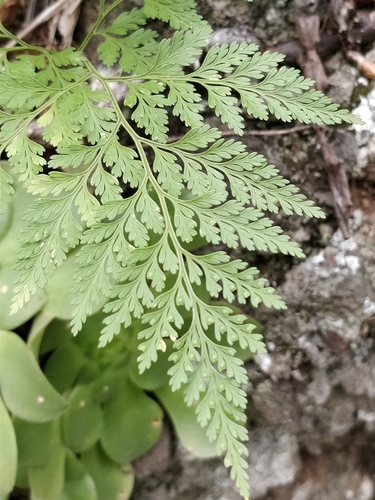
This fern features broadly triangular, finely dissected bright green fronds that typically grow between 20 and 60 centimeters in length, presenting an elegant, feathery appearance. However, its most defining visual trait is its network of creeping rhizomes at the base. These rhizomes are unusually thick (about 1 to 1.5 centimeters in diameter) and completely enveloped in soft, pale brown to silvery-white hairy scales. In the wild, these fuzzy structures weave across the surface of tree bark or rocks, avoiding burial in the soil and standing out visibly against the dark, damp greens of the forest.
Category
PlantsRarity
Common
Danger
1/5 · Very low
Snaps
Be the first to snap!
In the wild, this fern can survive surprisingly dry summers by dropping all of its lacy green fronds and remaining completely dormant until the rain returns.
The common name 'hare's-foot fern' comes directly from its thick, furry rhizomes that closely resemble the paws of a rabbit or hare.
Unlike terrestrial ferns that root deep in the soil, its fuzzy rhizomes always creep along the surface to prevent rotting in highly moist environments.
While it grows on other plants, it is not a parasite; it simply uses trees as a physical resting place to catch filtered sunlight and falling rain.
Uses its creeping rhizomes to firmly grip tree bark and rocks, elevating itself above the forest floor to access better light.
The dense hairs on its rhizomes act as a sponge to trap ambient humidity and protect the plant's core from drying out or sun damage.
Capable of completely shedding its green fronds during exceptionally dry summers to conserve water, resprouting vigorously when winter rains return.
Produces its own energy through photosynthesis, synthesizing nutrients from sunlight, water, and carbon dioxide.
Laurus novocanariensis
Provides an elevated trunk and branches for the fern to grow on as an epiphyte.
Erica arborea
Another common host tree in the Macaronesian laurel forests where the fern frequently anchors itself.
Cornu aspersum
Snails occasionally feed on the tender young fronds during excessively damp conditions.
No trait badges are assigned for this object yet.
No aliases listed yet.
Collections for this object will appear here as more themes are added.
Danger
1/5 · Very low
No special safety notes yet.
Compare frond shape, how the leaflets are arranged, the stalk, and any spore clusters you can see. A single detached leaflet often hides the plant's overall growth pattern. Fern Identifier: upload a photo and compare the visible details.
20-60 cm
10-50 years
Produces its own energy through photosynthesis, synthesizing nutrients from sunlight, water, and carbon dioxide.
Found thriving on damp, shaded rocks and the trunks of trees within the humid laurel forests and deep ravines of Macaronesia and the western Iberian Peninsula.
Zoom in to split clusters and explore where this object has been snapped.
Recent snaps will appear here as new observations are added.
Take the discovery with you
Snap it with Snappit to identify it, learn what makes it special, and add the discovery to your collection.