


Delonix
delonix
The genus Delonix consists of magnificent, deciduous flowering trees native to Madagascar and parts of East Africa, renowned globally for their spectacular floral displays. Commonly referred to as flamboyants or poincianas, these trees are celebrated for their wide-spreading, umbrella-like canopies that become completely smothered in brilliant scarlet, orange, or yellow blossoms during the warm season. Beyond their aesthetic appeal, Delonix species play an important ecological role, providing shade, stabilizing soils, and hosting a diverse array of pollinators. They have adapted remarkably well to tropical and subtropical climates, making them one of the most beloved ornamental trees cultivated across the globe.
Habitat: Typically found in tropical dry forests, rocky slopes, and coastal scrublands of Madagascar, though widely cultivated in urban gardens and parks globally.
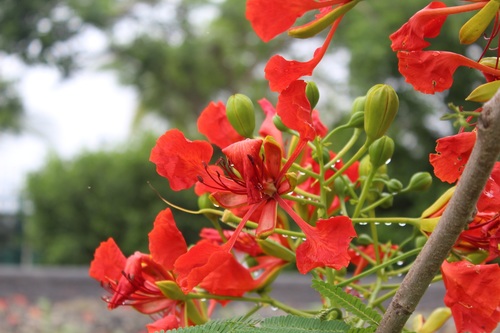
These trees are easily recognized by their massive, spreading canopy that forms an elegant, flat-topped umbrella shape, typically reaching heights of 5 to 15 meters. The trunk is greyish-brown and smooth, often featuring buttressed roots at the base. The leaves are bright green, bipinnately compound, and have a soft, fern-like appearance. When in bloom, the tree is a riot of color, characterized by large flowers with four spreading scarlet or orange-red petals and a fifth upright petal, called the standard, which is slightly larger and splashed with yellow and white markings.
Category
PlantsRarity
Common
Danger
1/5 · Very low
Snaps
Be the first to snap!
In Vietnam, where the tree blooms around the end of the school year, it is nicknamed the 'pupil's flower' and holds a nostalgic place in student culture.
In many Caribbean nations, the dry, woody seed pods of Delonix are used as a percussion instrument known as shak-shaks or maracas.
The common name 'Poinciana' honors Phillippe de Longvilliers de Poincy, a 17th-century governor of Saint Kitts who was an avid promoter of the tree.
The tree is exceptionally wind-resistant due to its flexible wood and low, spreading canopy, making it a valuable windbreak in storm-prone tropical coastal areas.
Form beneficial associations with soil bacteria to convert atmospheric nitrogen into nutrients, improving the surrounding soil quality.
Sheds its leaves entirely during prolonged dry periods to conserve water and survive extreme drought conditions.
Features an exceptionally wide, flat canopy that maximizes light capture while shading its own root system to reduce evaporation.
As a photoautotrophic plant, Delonix generates its own organic compounds and energy through photosynthesis, utilizing sunlight, water, carbon dioxide, and soil minerals.
Age differences: Seedlings rely on nutrient reserves stored within the seed cotyledons before developing functional leaves for photosynthesis.
Apis mellifera
Bees visit the vibrant flowers to collect nectar and pollen, acting as primary pollinators for the tree.
Achatina fulica
This invasive snail species often feeds on the tender young seedlings and fallen leaves of Delonix trees.

Phoebis sennae
Butterflies feed on the abundant nectar provided by the flowers and assist in cross-pollination.
No trait badges are assigned for this object yet.
Collections for this object will appear here as more themes are added.
Danger
1/5 · Very low
No special safety notes yet.
Start with the whole plant, then compare leaf arrangement, leaf edges, stems and any flowers or fruit. Opposite leaves grow in pairs; alternate leaves come one at a time along the stem. These details tell you far more together than a single green leaf does. Plant Identifier: upload a photo and compare the visible details.
500-1500 cm
2000-15000 kg
30-80 years
As a photoautotrophic plant, Delonix generates its own organic compounds and energy through photosynthesis, utilizing sunlight, water, carbon dioxide, and soil minerals.
Typically found in tropical dry forests, rocky slopes, and coastal scrublands of Madagascar, though widely cultivated in urban gardens and parks globally.
12-30 days
Zoom in to split clusters and explore where this object has been snapped.
Recent snaps will appear here as new observations are added.

Texas, US
You might spot Giraffes, African Lion, and Eastern Black Rhinoceros.
View guide →

Nouvelle-Aquitaine, FR
You might spot Greater Flamingo, Giraffes, and Red Panda.
View guide →

Kansas, US
You might spot Cotton-Top Tamarin, American Bison, and Cougar.
View guide →

Nevada, US
You might spot African Lion, Tiger, and Zebra.
View guide →

Andalusia, ES
You might spot Tiger, African Lion, and Delonix.
View guide →

Indiana, US
You might spot Giraffes, African Lion, and Tiger.
View guide →
Take the discovery with you
Snap it with Snappit to identify it, learn what makes it special, and add the discovery to your collection.


















