

Dicromantispa Interrupta
dicromantispa interrupta
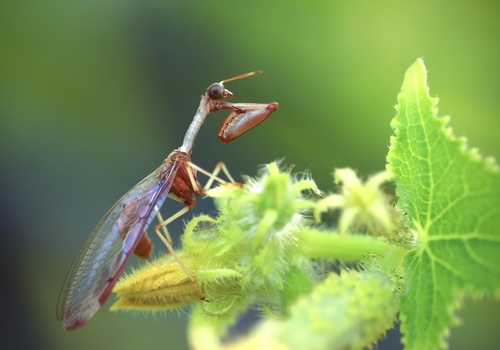
Meet Dicromantispa interrupta, a fascinating and dramatic member of the mantidfly family Mantispidae. Often called the interrupted mantidfly, this insect represents an incredible example of evolutionary convergence. While its raptorial forelegs and elongated prothorax make it look remarkably like a miniature praying mantis, it is actually a member of the order Neuroptera, making it more closely related to lacewings and antlions. This tiny predator is known for its wasp-like coloration and a specialized life cycle that links its survival directly to spiders. During its larval stage, Dicromantispa interrupta undergoes hypermetamorphosis, where larvae actively search for a female spider to board, waiting for her to spin an egg sac so they can feed on the eggs inside.
Habitat: Typically found in deciduous woodlands, forest edges, grasslands, and fields where spiders and small insects are abundant.
Dicromantispa interrupta features an elongated, amber to reddish-brown prothorax resembling a neck, with a total body length ranging from 1 to 3 centimeters. Its head is equipped with large, compound eyes and short antennae, while its striking raptorial forelegs are decorated with dark banding. Its wings are membranous and transparent, spanning up to 5 centimeters, and are characterized by a distinct dark, interrupted brownish-red band along the leading edge.
Category
InsectsRarity
Common
Danger
1/5 · Very low
Snaps
1
Despite looking almost identical to a praying mantis, mantidflies belong to an entirely different insect order, Neuroptera, making them closer relatives of lacewings.
If a mantidfly larva boards a male spider instead of a female, it will wait on him and transfer to a female spider during mating.
To deter predators, they mimic not only the appearance of paper wasps but also their jerky walking pattern and wing-flicking behavior.
Adults exhibit Batesian mimicry, sporting yellow, brown, and black patterns and wing-shaking behaviors that make them resemble stinging paper wasps to deter predators.
Possesses highly modified, muscular forelegs that can snap shut in milliseconds to snag agile prey like flies and moths.
Larvae can locate and board passing spiders, hitching a ride and feeding on the spider's hemolymph until an egg sac is produced.
Adults are active predators of small insects, while the specialized larvae feed exclusively on the eggs within spider egg sacs.
Age differences: Larvae are internal or external parasites of spiders and their egg sacs, whereas adults are free-living aerial predators.
Rabidosa rabida
Larvae parasitize the egg sacs of this wolf spider, occasionally boarding the mother first.
Drosophila melanogaster
Adults hunt and consume these small flies on vegetation.

Poecile carolinensis
Preyed upon by insectivorous birds nesting in forest margins.
No trait badges are assigned for this object yet.
No aliases listed yet.
Collections for this object will appear here as more themes are added.
Danger
1/5 · Very low
No special safety notes yet.
The easiest way to identify Dicromantispa Interrupta is to use the Snappit nature identifier app.
1-3 cm
2-5 cm
0.0001-0.0005 kg
1 years
Adults are active predators of small insects, while the specialized larvae feed exclusively on the eggs within spider egg sacs.
Typically found in deciduous woodlands, forest edges, grasslands, and fields where spiders and small insects are abundant.
Ambush
Zoom in to split clusters and explore where this object has been snapped.

Alabama, US
You might spot Painted Bunting, House Finch, and Red-Shouldered Hawk.
View guide →

Texas, US
You might spot Mediterranean House Gecko and Gulf Coast Toad.
View guide →
Take the discovery with you
Snap it with Snappit to identify it, learn what makes it special, and add the discovery to your collection.











.jpg&width=800)




