





Carolina Chickadee
Poecile carolinensis
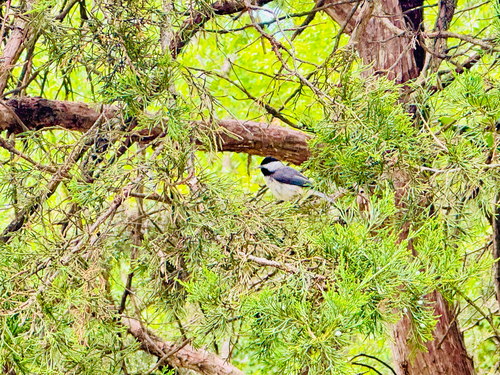
The Carolina Chickadee is a small, cheerful bird with a black cap and white cheeks. They love to flit around trees and are known for their sweet, whistling calls that sound like 'chick-a-dee-dee-dee'.
Habitat: Forests
The Carolina Chickadee is a small, plump songbird with a distinctive black cap and bib, contrasted by crisp white cheeks. Its back and wings are gray, while its belly is whitish with buffy sides, making it slightly less white on the wing edges compared to its northern cousin.
Category
BirdsRarity
Common
Danger
1/5 · Very low
Snaps
26
Carolina Chickadees fluff up their feathers to trap air and stay warm.
Chickadees often nest inside abandoned woodpecker holes or tiny tree cavities!
Their heart can beat over 500 times per minute when they are active!
This tiny bird can hang upside down to find hidden insects on branches!
Carolina Chickadee can recall hundreds of hidden food locations because its brain's memory center temporarily expands in the fall.
Carolina Chickadee can lower its body temperature at night (torpor) to save energy and survive freezing winter nights.
Carolina Chickadee has complex 'chick-a-dee-dee-dee' calls that communicate specific predator threats and their danger level.
These tiny birds feast on insects, spiders, seeds, and berries, especially in colder months!
Feathered describes animals, primarily birds, possessing a covering of feathers.
Social animals live in organized groups, cooperating for survival benefits such as foraging, defense, and raising offspring.
Singing animals produce complex vocalizations, often for purposes of attracting mates, defending territory, or communicating within their species.
This trait identifies organisms whose diet primarily consists of insects and other small invertebrates.

Forest habitats are terrestrial environments dominated by dense tree cover, supporting a high diversity of plant and animal life.

Diurnal animals are primarily active during daylight hours, typically resting or sleeping at night.
Danger
1/5 · Very low
Enjoy watching birds from a distance and don't try to touch them.
The easiest way to identify Carolina Chickadee is to use the Snappit nature identifier app.
11.5-13 cm
16-20 cm
0.009-0.012 kg
2-7 years
35 km/h
These tiny birds feast on insects, spiders, seeds, and berries, especially in colder months!
Forests
Zoom in to split clusters and explore where this object has been snapped.
May 14, 2026
Dickerson Park ZooPhoto attribution
(c) Lucky Okpanachi Atabo, some rights reserved (CC BY)
License: CC BY 4.0 ↗
Image may be shown cropped inside the card frame.

Maryland, US
You might spot Osprey, Duck, and Spotted Lanternfly.
View guide →

Virginia, US
You might spot Northern Cardinal and Eastern Gray Squirrel.
View guide →
Maryland, US
You might spot Duck, American Toad, and Eastern Bluebird.
View guide →

Virginia, US
You might spot Eastern Tiger Swallowtail, Fowler's Toad, and Monarch.
View guide →

Texas, US
You might spot Brown Anole, Gulf Fritillary, and Pond Slider.
View guide →

Tennessee, US
You might spot Pond Slider, White-Tailed Deer, and Great Blue Heron.
View guide →
Take the discovery with you
Snap it with Snappit to identify it, learn what makes it special, and add the discovery to your collection.





.jpg&width=800)








