

Dotted Wild Coffee
psychotria punctata
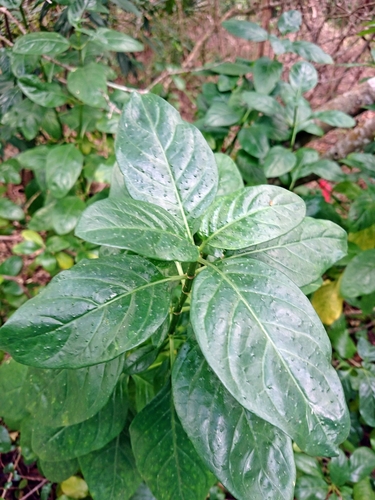
Dotted Wild Coffee (Psychotria punctata) is an intriguing evergreen shrub native to the tropical and subtropical forests of East Africa. While it shares the Rubiaceae family with commercial coffee plants, it is not used for coffee production. Instead, it is celebrated for its unique botanical features, most notably the tiny blackish dots scattered across its glossy green leaves. These dots are not signs of disease, but rather specialized chambers containing symbiotic bacteria that play a key role in the plant's development and defense. Growing as a mid-sized understory shrub, Dotted Wild Coffee contributes to the complex layering of its native forests. It produces dense clusters of small, white, tube-shaped flowers that eventually give way to vibrant, cherry-red berries. These berries are a crucial food source for local bird populations, ensuring the plant's seeds are dispersed throughout its habitat. Its attractive, dark green foliage and tolerance for shade have also made it a popular ornamental plant in tropical gardens worldwide.
Habitat: Typically found in the shaded understories of moist tropical forests, coastal evergreen thickets, and riverine woodlands.
This evergreen shrub typically grows between 1 to 3 meters in height, displaying an erect, bushy form. Its most identifying feature is the glossy, deep green, elliptic to obovate leaves that grow in opposite pairs. On the undersides of these leaves, one can observe numerous distinct, dark, pinhead-sized dots or nodules, which are specialized bacterial housing structures. The plant produces terminal clusters of small, fragrant, tubular white or cream-colored flowers. Following pollination, these blooms develop into small, fleshy, spherical drupes that turn a striking bright red when fully ripe, closely resembling small coffee berries.
Category
PlantsRarity
Common
Danger
1/5 · Very low
Snaps
Be the first to snap!
Although called wild coffee, its berries do not contain caffeine and are not used to make the popular morning beverage.
The 'dots' on the leaf undersides are actually homes for symbiotic bacteria, a relationship highly unusual for plants outside of the legume family.
The genus name Psychotria is derived from the Greek word 'psyche', referring to the powerful chemical properties found in many species of this genus.
Features specialized leaf nodules harboring symbiotic Burkholderia bacteria, which assist in leaf development and may produce defensive chemicals.
Possesses highly glossy, broad leaves designed to maximize light absorption in low-light forest understories.
Produces highly visible, contrasting red berries that specifically target fruit-eating birds to facilitate seed dispersal.
As an autotrophic plant, it produces its own energy via photosynthesis using sunlight, water, and carbon dioxide, aided by its symbiotic leaf bacteria.
Pycnonotus barbatus
The common bulbul consumes the bright red drupes of the shrub, acting as a primary seed disperser.
Candidatus Burkholderia kirkii
This bacterium lives symbiotically inside the specialized leaf nodules of the plant, assisting in its health and development.
Coccus viridis
This sap-sucking pest feeds on the leaves and stems, potentially reducing the plant's overall vigor.
No trait badges are assigned for this object yet.
No aliases listed yet.
Collections for this object will appear here as more themes are added.
Danger
1/5 · Very low
No special safety notes yet.
Start with the whole plant, then compare leaf arrangement, leaf edges, stems and any flowers or fruit. Opposite leaves grow in pairs; alternate leaves come one at a time along the stem. These details tell you far more together than a single green leaf does. Plant Identifier: upload a photo and compare the visible details.
100-300 cm
10-40 years
As an autotrophic plant, it produces its own energy via photosynthesis using sunlight, water, and carbon dioxide, aided by its symbiotic leaf bacteria.
Typically found in the shaded understories of moist tropical forests, coastal evergreen thickets, and riverine woodlands.
30-90 days
Zoom in to split clusters and explore where this object has been snapped.
Recent snaps will appear here as new observations are added.
Take the discovery with you
Snap it with Snappit to identify it, learn what makes it special, and add the discovery to your collection.