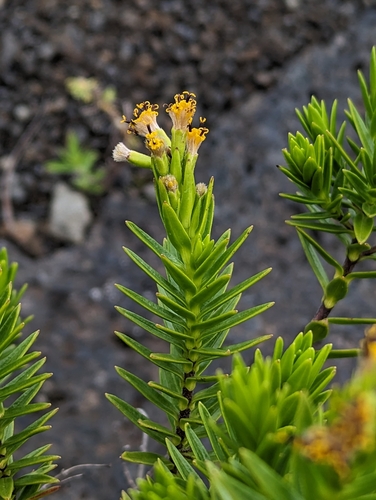


Dubautia Ciliolata
dubautia ciliolata
Dubautia ciliolata, commonly known as na'ena'e, is a remarkable evergreen shrub endemic to the island of Hawaii. Growing directly out of harsh, barren basaltic lava flows, this resilient plant is a member of the famous Hawaiian silversword alliance. It represents one of the most stunning examples of adaptive radiation in the botanical world, where a single ancestral colonist from North America evolved into dozens of highly diverse species spanning alpine heights to wet rainforests. With its compact, dome-like growth habit and vibrant clusters of yellow flowers, Dubautia ciliolata brings life to some of the youngest and most sterile landscapes on Earth. It serves as an essential pioneer species, trapping dust, organic matter, and moisture to help kickstart soil formation on fresh lava fields.
Habitat: Found in high-elevation subalpine shrublands and pioneering barren basaltic lava flows on the island of Hawaii.
This plant is a small, densely branched shrub reaching up to 150 centimeters in height, often taking on a rounded, compact form. Its leaves are small, stiff, and lance-shaped, measuring about 1 to 2 centimeters long, and are densely crowded along the branches. A key identification feature is the presence of fine, eyelash-like hairs along the edges of the leaves. During its blooming period, it produces striking, tight inflorescences at the branch tips containing small, tubular, bright yellow flowers.
Category
PlantsRarity
Common
Danger
1/5 · Very low
Snaps
2
Despite looking like a small woody shrub, it is closely related to the famous Hawaiian silversword, sharing a common ancestor that arrived in Hawaii millions of years ago.
Its wood and leaves contain sticky resins that help protect the plant from extreme water loss and deter opportunistic insect pests.
The species name 'ciliolata' comes from the Latin word for eyelashes, referencing the dense fringe of fine hairs on its leaf margins.
Highly adapted to colonizing newly cooled basaltic lava flows, establishing roots in barren cracks where few other plants can survive.
The fine, eyelash-like hairs on the leaf margins help capture atmospheric moisture from passing volcanic fog, channeling water down to the plant's roots.
Thick, leathery leaves and a compact growth form reduce transpiration, allowing the plant to withstand the intense, dry sun of high elevations.
As a photoautotroph, this species synthesizes its own sugars using sunlight, carbon dioxide, and water while absorbing key mineral nutrients from weathered volcanic soils.
Hylaeus anthracinus
Pollinated by endemic bees that feed on its abundant nectar.
Capra hircus
Foliage and bark are heavily browsed by destructive introduced feral animals.
Thyrocopa apatela
Provides essential microhabitat and nectar for native Hawaiian moths.
No trait badges are assigned for this object yet.
No aliases listed yet.
Collections for this object will appear here as more themes are added.
Danger
1/5 · Very low
No special safety notes yet.
The easiest way to identify Dubautia Ciliolata is to use the Snappit nature identifier app.
30-150 cm
10-50 years
As a photoautotroph, this species synthesizes its own sugars using sunlight, carbon dioxide, and water while absorbing key mineral nutrients from weathered volcanic soils.
Found in high-elevation subalpine shrublands and pioneering barren basaltic lava flows on the island of Hawaii.
Zoom in to split clusters and explore where this object has been snapped.
Take the discovery with you
Snap it with Snappit to identify it, learn what makes it special, and add the discovery to your collection.












.jpg&width=800)



_001.jpg&width=800)




