
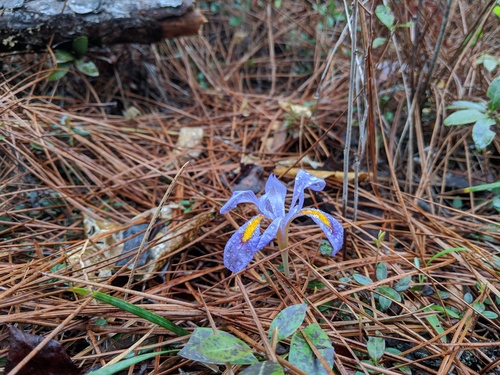


Dwarf Iris
iris verna
The Dwarf Iris (Iris verna) is a charming, low-growing wildflower native to the acidic woodlands and open pine forests of the eastern United States. Signaling the arrival of spring, this diminutive perennial emerges with striking, violet-blue blossoms that seem to glow against the leaf-littered forest floor. Unlike its close relatives, this species thrives in nutrient-poor, sandy, and acidic soils, showing remarkable resilience in pine-dominated ecosystems. What makes the Dwarf Iris particularly fascinating is its evolutionary strategy. Lacking the raised ridges or crests of other dwarf irises, it features a smooth, brilliant orange-yellow signal band on its lower petals to guide native pollinators directly to its nectar. Its sweet, subtle fragrance and compact stature make it a highly sought-after find for hikers and native plant enthusiasts exploring sandy ridges and open woodlands in early spring.
Habitat: Found in acidic, well-drained soils of open pine-oak woods, ridges, and clearing edges across the southeastern United States.
Standing only 5 to 15 cm tall, the Dwarf Iris features upright, sword-like, dark green leaves that grow in fan-like clusters, often expanding further after the blooming period. The flowers are solitary, measuring about 4 to 5 cm across, and showcase a deep violet-blue to lavender hue. The three drooping petals, or falls, are adorned with a striking, smooth, yellow-to-bright-orange band at their base, which acts as a nectar guide, while the three upright petals, or standards, are solid blue-violet and slightly narrower. It is easily distinguished from the similar Crested Dwarf Iris by its lack of raised ridges or crests along this yellow signal.
Category
PlantsRarity
Common
Danger
1/5 · Very low
Snaps
Be the first to snap!
The Dwarf Iris has a surprisingly sweet, delicate fragrance, a feature that distinguishes it from many other wild iris species that lack scent entirely.
The seeds of this species rely on a process called myrmecochory, where ants act as tiny gardeners, carrying and planting the seeds underground.
Unlike the common Dwarf Crested Iris, Iris verna has a completely smooth yellow signal band without any ridges or physical 'crests' on its petals.
It is highly adapted to grow and thrive in nutrient-deficient, highly acidic, and sandy soils where many other wildflower species cannot survive.
Produces seeds with lipid-rich structures called elaiosomes that entice forest ants to transport and plant them in underground chambers.
Utilizes a smooth, bright yellow-orange patch on its petals that reflects specific light wavelengths to guide pollinating insects directly to its reproductive organs.
As a photosynthetic plant, the Dwarf Iris produces its own food by converting sunlight, carbon dioxide, and water into chemical energy.
Bombus pennsylvanicus
Provides early spring pollen and nectar to native bumblebees, which serve as its primary pollinators.
Aphaenogaster rudis
Ants collect and carry the seeds to their nests to feed on the nutritious elaiosome appendages, dispersing the seeds in the process.

Odocoileus virginianus
Occasionally browses the foliage and flowers, though the plant is generally avoided due to mild toxins in the rhizomes.
No trait badges are assigned for this object yet.
No aliases listed yet.
Collections for this object will appear here as more themes are added.
Danger
1/5 · Very low
No special safety notes yet.
Start with the whole plant, then compare leaf arrangement, leaf edges, stems and any flowers or fruit. Opposite leaves grow in pairs; alternate leaves come one at a time along the stem. These details tell you far more together than a single green leaf does. Plant Identifier: upload a photo and compare the visible details.
5-15 cm
5-15 years
As a photosynthetic plant, the Dwarf Iris produces its own food by converting sunlight, carbon dioxide, and water into chemical energy.
Found in acidic, well-drained soils of open pine-oak woods, ridges, and clearing edges across the southeastern United States.
Photosynthesis
60-120 days
Zoom in to split clusters and explore where this object has been snapped.
Recent snaps will appear here as new observations are added.
Take the discovery with you
Snap it with Snappit to identify it, learn what makes it special, and add the discovery to your collection.


















