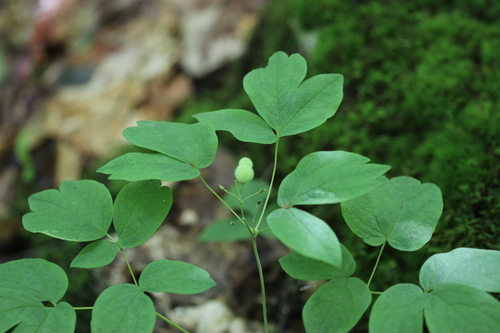


Early Blue Cohosh
caulophyllum giganteum
The Early Blue Cohosh (Caulophyllum giganteum) is a striking herbaceous perennial known for its early emergence in spring, often being one of the first plants to push through the forest floor. It is a captivating member of the barberry family, admired for its unique purplish-bronze foliage that matures to a lush green and its unusual, berry-like blue seeds. This plant plays a vital role in its woodland ecosystem, providing early nectar for pollinators and its seeds serving as food for birds. Its distinctive appearance and fascinating life cycle make it a standout species in temperate deciduous forests, hinting at the vibrant botanical tapestry that will soon follow the chill of winter.
Habitat: Found in rich, moist deciduous forests, often on slopes, floodplains, or along streams, preferring fertile, humus-rich soil.
Early Blue Cohosh typically grows 30-90 cm tall, featuring a stout, often purplish-bronze stem in spring that gradually turns green. Its large, compound leaves are divided into three parts, each further divided into three leaflets, giving them a distinctive, somewhat lacy appearance. Small, yellowish-green to brownish-purple flowers emerge in early spring, clustered at the top of the stem. The most distinctive feature are its seeds, which mature in summer, appearing as brilliant blue, pea-sized, 'naked' seeds held on short stalks, resembling berries.
Category
PlantsRarity
Common
Danger
1/5 · Very low
Snaps
1
Early Blue Cohosh is one of the few plants that can grow well under the dense shade of mature trees, thanks to its ability to emerge and photosynthesize early in the spring before the tree canopy develops.
Its striking blue seeds are often mistaken for berries, but they are technically 'naked' seeds, not enclosed in a fleshy fruit.
The name 'Cohosh' is derived from an Algonquin word meaning 'rough,' referring to its rootstock.
The plant's distinctive early spring coloration, ranging from purplish-bronze to bluish-green, helps it absorb more sunlight in the cooler temperatures of early spring.
This plant is one of the earliest to emerge in spring, often appearing with purplish-bronze shoots before many other woodland plants have begun their growth. This early start allows it to capture sunlight before the forest canopy leafs out.
Unlike most plants that produce seeds fully enclosed within a fruit, Early Blue Cohosh produces 'naked' seeds that are exposed on short stalks. These strikingly blue, berry-like seeds are a unique botanical feature.
Historically, various parts of the plant, particularly the rhizome and roots, have been used in traditional herbal medicine by indigenous peoples for a range of ailments, especially in women's health.
As an autotrophic plant, Early Blue Cohosh produces its own food through the process of photosynthesis, converting sunlight, water, and carbon dioxide into sugars for energy and growth. It absorbs essential nutrients from the soil via its root system.
Andrena erigeniae
Pollinates flowers to enable seed production.
Turdus migratorius
Consumes the blue seeds, aiding in seed dispersal to new locations.
Glomeromycota species
Forms a symbiotic relationship with roots to enhance nutrient and water absorption from the soil.

Odocoileus virginianus
May browse on foliage, although the plant is often avoided due to its mild toxicity.
No trait badges are assigned for this object yet.
No aliases listed yet.
Collections for this object will appear here as more themes are added.
Danger
1/5 · Very low
No special safety notes yet.
Start with the whole plant, then compare leaf arrangement, leaf edges, stems and any flowers or fruit. Opposite leaves grow in pairs; alternate leaves come one at a time along the stem. These details tell you far more together than a single green leaf does. Plant Identifier: upload a photo and compare the visible details.
30-90 cm
0.1-0.5 kg
5-15 years
As an autotrophic plant, Early Blue Cohosh produces its own food through the process of photosynthesis, converting sunlight, water, and carbon dioxide into sugars for energy and growth. It absorbs essential nutrients from the soil via its root system.
Found in rich, moist deciduous forests, often on slopes, floodplains, or along streams, preferring fertile, humus-rich soil.
Photosynthesis And Nutrient Absorption
Zoom in to split clusters and explore where this object has been snapped.

Massachusetts, US
You might spot Common Eastern Bumble Bee and Eastern Skunk Cabbage.
View guide →

New York, US
You might spot Allegheny Mountain Dusky Salamander.
View guide →

Massachusetts, US
You might spot Hemlock Woolly Adelgid, Eastern Newt, and Red Trillium.
View guide →
Take the discovery with you
Snap it with Snappit to identify it, learn what makes it special, and add the discovery to your collection.