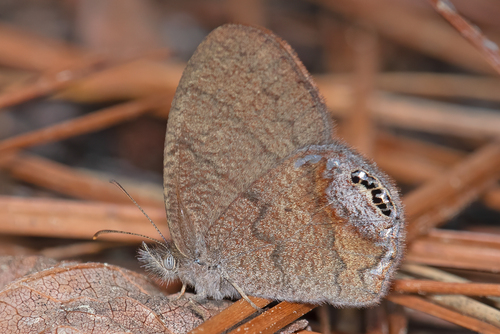


Eastern Gemmed-Satyr
cyllopsis gemma
The Eastern Gemmed-Satyr (Cyllopsis gemma) is a delightful and subtle resident of the damp, shaded woodlands of the southeastern United States. Often overlooked due to its low, bobbing flight pattern near the forest floor, this small butterfly reveals spectacular hidden beauty upon closer inspection. While its upper wings are a modest, uniform grayish-brown, the underside of its hindwings features a row of metallic, silver-and-gold spots—the 'gems' that give the species its name. Unlike many butterflies that flutter high in the canopy or visit bright flowers, the Eastern Gemmed-Satyr prefers the dim understory, feeding on sap, rotting fruit, and moisture. Its presence is a testament to the health of grassy woodland floors and riparian margins.
Habitat: Found in damp, deciduous woodlands, coastal plains, and riparian corridors, typically near slow-moving streams or swampy margins where host grasses grow.
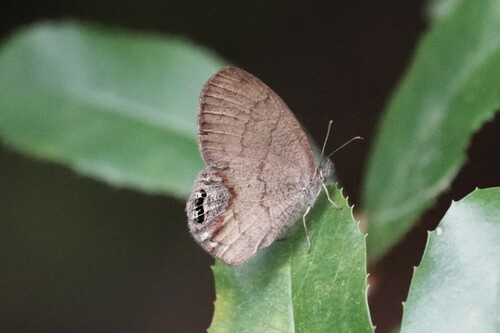
A small butterfly with a wingspan ranging from 3 to 5 cm, the Eastern Gemmed-Satyr exhibits a mostly plain, soft grayish-brown color on its upperside. Its most defining characteristic is on the underside of the hindwing: a prominent row of four or five small, dark, circular spots glistening with metallic silver and gold centers, bordered by a delicate rusty-red or copper line. The underside also displays faint, wavy, reddish-brown lines traversing the wings, helping it blend seamlessly into dead leaves and forest floor debris when resting.
Category
InsectsRarity
Common
Danger
1/5 · Very low
Snaps
1
Its flight is remarkably low and bouncy, rarely rising more than a foot or two above the leaf litter of the forest floor.
The metallic 'gems' on the edges of its hindwings act as a deflective target, tricking predators into attacking the wing margins rather than its vulnerable body.
Unlike most butterflies, the Eastern Gemmed-Satyr rarely visits flowers for nectar, preferring moisture and nutrients from mud, sap, and dung.
The intricate, leaf-like patterns on the underside of its wings allow it to disappear completely against the leaf litter when its wings are folded.
It flies in a slow, bouncing manner very close to the ground, navigating through dense grass and undergrowth to evade aerial predators.
It has adapted to seek out non-floral sources of moisture and nutrients, utilizing a specialized proboscis to feed on tree sap, dung, and decaying organic matter.
Adults feed on decaying organic materials like rotting fruit, tree sap, and animal dung, while caterpillars feed exclusively on various grasses.
Age differences: Larvae are strictly herbivorous, feeding on grasses like Bermuda grass, whereas adults transition to a liquid diet of sap, rotting fruit, and dung.

Cynodon dactylon
The caterpillar larvae of the Eastern Gemmed-Satyr feed on the leaves of this grass as their primary food source.

Poecile carolinensis
This small insectivorous bird preys on the caterpillars and adult butterflies of the Eastern Gemmed-Satyr.

Hyla cinerea
Often sharing the same damp, grassy habitats, this treefrog opportunistically preys on low-flying adults.
No trait badges are assigned for this object yet.
No aliases listed yet.
Collections for this object will appear here as more themes are added.
Danger
1/5 · Very low
No special safety notes yet.
The easiest way to identify Eastern Gemmed-Satyr is to use the Snappit nature identifier app.
1+ cm
3+ cm
0.0001+ kg
8 km/h
Adults feed on decaying organic materials like rotting fruit, tree sap, and animal dung, while caterpillars feed exclusively on various grasses.
Found in damp, deciduous woodlands, coastal plains, and riparian corridors, typically near slow-moving streams or swampy margins where host grasses grow.
Foraging
Zoom in to split clusters and explore where this object has been snapped.
Jun 7, 2026
Locust Grove State Historic SitePhoto attribution
(c) Brandon Johnson, some rights reserved (CC BY)
License: CC BY 4.0 ↗
Image may be shown cropped inside the card frame.
Take the discovery with you
Snap it with Snappit to identify it, learn what makes it special, and add the discovery to your collection.













.jpg&width=800)




