
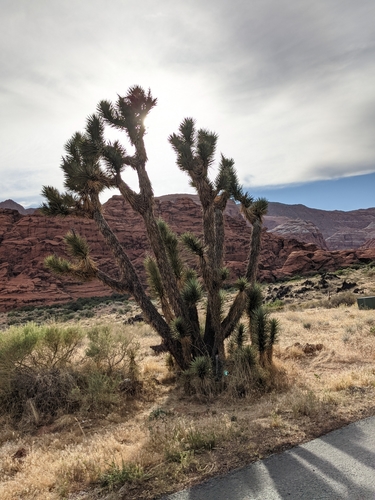


Eastern Joshua Tree
yucca jaegeriana
The Eastern Joshua Tree (Yucca jaegeriana) is a striking, iconic succulent tree native to the arid desert landscapes of the Southwest. Once classified alongside the Western Joshua Tree, this species stands out due to its smaller overall stature and a distinct tendency to branch much closer to the ground, giving it a denser, bushier appearance. It thrives in the harsh, sun-drenched Mojave Desert, carving out a survival strategy that has endured for centuries. This charismatic plant is not just a visual symbol of the American desert; it is an ecological cornerstone. It forms a highly specialized, mutualistic bond with the Eastern Joshua Tree moth, which is vital for the tree's pollination and the moth's reproduction. Observing these ancient plants set against vast desert horizons offers a profound connection to the resilient natural history of North America's arid regions.
Habitat: Found in gravelly plains, bajadas, and moderate slopes across the high-elevation zones of the eastern Mojave Desert.
The Eastern Joshua Tree is a compact, tree-like succulent typically growing between 2 and 6 meters tall. It features a shaggy, fibrous trunk covered in gray-brown bark and dead leaf thatch. Its branches, which begin lower on the trunk than its western counterpart, are capped with dense, rosette-like clusters of stiff, sword-shaped leaves. These leaves are blue-green, sharply pointed, and finely serrated along the edges. In spring, tight panicles of heavy, cream-to-greenish-white flowers emerge from the branch tips, eventually developing into thick, fleshy seed pods.
Category
PlantsRarity
Common
Danger
1/5 · Very low
Snaps
Be the first to snap!
Because Joshua Trees do not produce typical tree rings, scientists must estimate their age based on growth rates, which averages only about 3 to 7 centimeters per year.
Mormon pioneers are said to have named the Joshua Tree because its unique outstretched branches reminded them of the biblical figure Joshua waving them toward the promised land.
The Eastern Joshua Tree branches much lower and more frequently than the Western variety, giving it a distinctively compact and stout silhouette.
Its low, dense branching pattern helps dissipate wind forces and reduces exposure to scorching desert heat.
The thick cuticle and waxy outer layer of its needle-sharp leaves restrict water loss during extreme droughts.
It relies on a highly specialized partnership with a single moth species for pollination, ensuring genetic survival.
As a photosynthetic succulent, it manufactures its own energy from sunlight, water, and carbon dioxide.
Tegeticula antithetica
Relies exclusively on this moth species for pollination, while providing seeds as nourishment for the moth larvae.
Neotoma lepida
Feeds on the fibrous leaves and seed pods, often building protective middens around the base of the trunk.

Dryobates scalaris
Excavates nesting cavities in the soft woody branches of older trees.
No trait badges are assigned for this object yet.
No aliases listed yet.
Collections for this object will appear here as more themes are added.
Danger
1/5 · Very low
No special safety notes yet.
Start with the whole plant, then compare leaf arrangement, leaf edges, stems and any flowers or fruit. Opposite leaves grow in pairs; alternate leaves come one at a time along the stem. These details tell you far more together than a single green leaf does. Plant Identifier: upload a photo and compare the visible details.
200+ cm
100+ kg
100+ years
As a photosynthetic succulent, it manufactures its own energy from sunlight, water, and carbon dioxide.
Found in gravelly plains, bajadas, and moderate slopes across the high-elevation zones of the eastern Mojave Desert.
Zoom in to split clusters and explore where this object has been snapped.
Recent snaps will appear here as new observations are added.
Take the discovery with you
Snap it with Snappit to identify it, learn what makes it special, and add the discovery to your collection.

















