
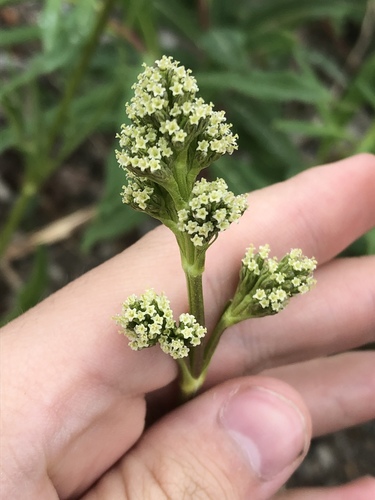


Edible Valerian
valeriana edulis
Edible Valerian (Valeriana edulis), also known as tobacco root, is a robust perennial wildflower native to the wet meadows and mountainous regions of western North America. Belonging to the Caprifoliaceae family, this fascinating plant is renowned not just for its ecological importance but for its rich ethnobotanical history. Indigenous peoples across the Rocky Mountains and Great Basin historically relied on its thick, carbohydrate-rich taproot as a vital food source, utilizing specialized long-duration pit-cooking techniques to make the roots sweet and digestible. In the wild, Edible Valerian serves as a resilient anchor in moist soil communities. Its towering flower stalks rise high above damp soils, providing nectar for a wide variety of native pollinators while its dense root system prevents soil erosion along montane streams.
Habitat: Found in moist montane meadows, damp mountain valleys, fens, and open pine forests, often growing in saturated soils near streams.
This plant is easily identified by its thick, fleshy basal rosette of long, strap-like leaves that feature prominent parallel veins and smooth margins. From this low-growing cluster, a sturdy, hollow flowering stem rises between 30 and 120 centimeters tall, terminating in a dense, branched, panicle-like cluster of small, creamy white to pale yellow flowers. The species is largely dioecious, meaning individual plants bear either male or female flowers, with male flowers presenting a slightly more open, delicate appearance. Its thick, yellowish-brown taproot is highly distinct, giving off a strong, pungent, earthy aroma when bruised or exposed.
Category
PlantsRarity
Common
Danger
1/5 · Very low
Snaps
Be the first to snap!
Because the raw root contains indigestible inulin, Native Americans would steam it in earth ovens for up to 48 hours to convert the starches into sweet, edible sugars.
Its tiny seeds are equipped with feathery, parachute-like structures that allow them to be carried long distances by mountain winds.
The raw root of Edible Valerian smells incredibly pungent, often compared to wet socks, earning it the descriptive common name 'tobacco root'.
The plant develops an incredibly thick, deep taproot that allows it to store dense complex carbohydrates (inulin) to survive freezing alpine winters.
It synthesizes strong-smelling valerenic and isovaleric acids within its roots, which act as a powerful chemical shield against underground burrowing pests.
Adapted to saturated wetland soils, its root system can withstand prolonged periods of low oxygen by utilizing specialized cellular pathways.
As a photoautotrophic plant, Edible Valerian manufactures its own organic compounds by capturing solar energy and drawing moisture and essential nutrients from wet mountain soils.

Ursus arctos horribilis
Digs up and consumes the highly nutritious, energy-dense taproots, especially during the spring and fall.
Bombus huntii
Pollinates the tiny, nectar-rich white flowers during the peak of summer.
Ochotona princeps
Feeds on the soft green foliage and stems in high-altitude meadows.
No trait badges are assigned for this object yet.
No aliases listed yet.
Collections for this object will appear here as more themes are added.
Danger
1/5 · Very low
No special safety notes yet.
Start with the whole plant, then compare leaf arrangement, leaf edges, stems and any flowers or fruit. Opposite leaves grow in pairs; alternate leaves come one at a time along the stem. These details tell you far more together than a single green leaf does. Plant Identifier: upload a photo and compare the visible details.
30-120 cm
0.05-0.6 kg
3-10 years
As a photoautotrophic plant, Edible Valerian manufactures its own organic compounds by capturing solar energy and drawing moisture and essential nutrients from wet mountain soils.
Found in moist montane meadows, damp mountain valleys, fens, and open pine forests, often growing in saturated soils near streams.
Zoom in to split clusters and explore where this object has been snapped.
Recent snaps will appear here as new observations are added.
Take the discovery with you
Snap it with Snappit to identify it, learn what makes it special, and add the discovery to your collection.


















