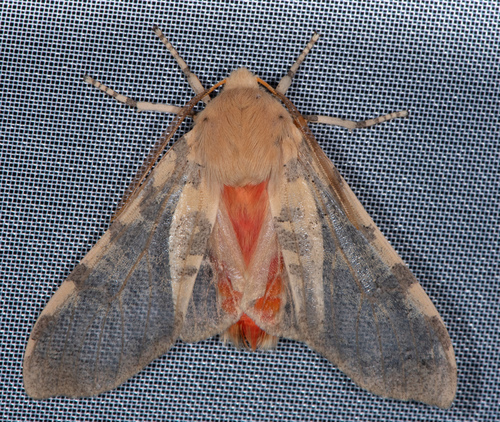


Edwards' Glassy-Wing Moth
pseudohemihyalea edwardsii
The Edwards' Glassy-Wing Moth is an enchanting tiger moth native to the coastal and montane oak woodlands of western North America. Named in honor of the 19th-century entomologist Henry Edwards, this delicate insect is celebrated for its unique aesthetic and specialized life cycle. As caterpillars, they are voracious consumers of oak leaves, playing a crucial role in cycling nutrients within their forest ecosystems. Once they metamorphose into adults, they emerge with a singular focus: reproduction. Because adults lack functional mouthparts, they must rely entirely on energy reserves stored during their caterpillar days, making their brief adult lives a race against time to secure the next generation. Their nocturnal habits and attraction to light sources make them a fascinating subject for night-time nature observers and citizen scientists.
Habitat: Typically found in oak woodlands, mixed evergreen forests, and chaparral of western North America.
Adult moths boast a wingspan of 5 to 7 centimeters and are easily recognized by their semi-translucent, amber-to-pale-yellow wings which feature delicate, faint brown wavy bands. Their heavy, robust bodies display a stark contrast, featuring a densely furry greyish-brown thorax and a vibrant pinkish-orange or bright reddish abdomen marked with neat longitudinal rows of small black spots. Their antennae are slender, and when resting, they hold their wings roof-like over their colorful bodies.
Category
InsectsRarity
Common
Danger
1/5 · Very low
Snaps
Be the first to snap!
The 'glassy' translucent quality of their wings is due to a reduced density of wing scales compared to other moth species.
Their caterpillars are covered in dense, stiff hairs that make them highly unpalatable to most birds and small mammalian predators.
Unlike most moths, the adult Edwards' Glassy-Wing does not possess a functional digestive system and will never eat a single meal during its adult life.
They possess specialized tymbal organs that produce ultrasonic clicks to jam the echolocation of hunting bats, effectively rendering themselves invisible.
The caterpillars are uniquely adapted to consume and neutralize high concentrations of toxic tannins found in oak leaves.
Their semi-transparent wings mimic the look of dry, skeletal leaves and dappled light, helping them blend seamlessly into forest foliage.
Caterpillars feed exclusively on the foliage of oak species, while the adult moths do not feed at all due to their vestigial mouthparts.

Quercus agrifolia
Larvae feed on the leaves of this evergreen oak tree as their primary host plant.
Myotis californicus
Bats prey upon the flying adult moths, though they are often confused by the moth's sonic clicks.
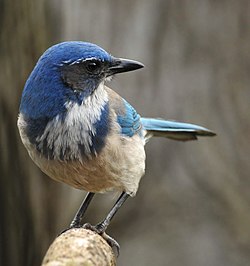
Aphelocoma californica
Diurnal birds opportunistically hunt resting adult moths and the highly visible, bristly caterpillars.
No trait badges are assigned for this object yet.
No aliases listed yet.
Collections for this object will appear here as more themes are added.
Danger
1/5 · Very low
No special safety notes yet.
Compare resting wing shape, forewing markings, antennae and body build. Small brown moths can hinge on fine details a phone photo can't always catch. Moth Identifier: upload a photo and compare the visible details.
2+ cm
5+ cm
0.0001+ kg
1+ years
12 km/h
Caterpillars feed exclusively on the foliage of oak species, while the adult moths do not feed at all due to their vestigial mouthparts.
Typically found in oak woodlands, mixed evergreen forests, and chaparral of western North America.
Zoom in to split clusters and explore where this object has been snapped.
Recent snaps will appear here as new observations are added.
Take the discovery with you
Snap it with Snappit to identify it, learn what makes it special, and add the discovery to your collection.