





California Scrub-Jay
Aphelocoma californica
The California Scrub-Jay is a cheerful blue bird that loves to hop around in trees and bushes. They are very smart and can even remember where they hide their food!
Habitat: Urban areas
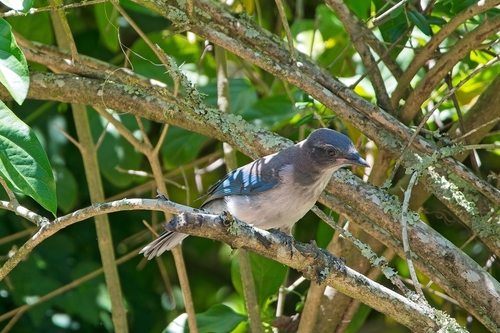
The California Scrub-Jay has striking sky-blue wings, tail, and head, contrasted with a grey back and white belly. A thin blue necklace often separates its throat from its chest. Unlike many jays, it lacks a crest.
Category
BirdsRarity
Common
Danger
1/5 · Very low
Snaps
49
A scrub-jay can remember where it buried up to 5,000 acorns and seeds!
These clever birds can recognize individual human faces they encounter often!
They sometimes imitate the calls of hawks to scare off rivals from food.
They sometimes trick other birds by pretending to hide food in empty spots.
California Scrub-Jays can remember thousands of food cache locations because their sharp memory helps them find buried treats months later.
California Scrub-Jays help grow oak forests because they bury acorns and sometimes forget them, letting new trees sprout.
California Scrub-Jays can solve complex problems and even use tools because their clever minds help them find tricky food.
These smart birds feast on a mix of tasty plants and small creatures, especially acorns!
Feathered describes animals, primarily birds, possessing a covering of feathers.
Social animals live in organized groups, cooperating for survival benefits such as foraging, defense, and raising offspring.
This trait identifies organisms whose diet includes both plant and animal matter.
Singing animals produce complex vocalizations, often for purposes of attracting mates, defending territory, or communicating within their species.

Colorful describes organisms or objects displaying a wide range of bright and distinct colors.

This trait describes organisms that manipulate external objects to achieve a specific goal.

This trait characterizes organisms with an exceptionally long lifespan compared to others of their kind.

Diurnal animals are primarily active during daylight hours, typically resting or sleeping at night.

This habitat trait indicates species that can coexist with humans in urban and suburban environments, utilizing man-made structures and green spaces.
Danger
1/5 · Very low
It's best to watch birds from a distance and not to disturb their nests.
The easiest way to identify California Scrub-Jay is to use the Snappit nature identifier app.
27-31 cm
38-46 cm
0.07-0.1 kg
9-19 years
35 km/h
These smart birds feast on a mix of tasty plants and small creatures, especially acorns!
Urban areas
Zoom in to split clusters and explore where this object has been snapped.
Jun 5, 2026
Sonoma PlazaPhoto attribution
(c) Daveozric, some rights reserved (CC BY)
License: CC BY 4.0 ↗
Image may be shown cropped inside the card frame.

California, US
You might spot Acorn Woodpecker and Western Fence Lizard.
View guide →

California, US
You might spot Redwood, Pacific Trillium, and Evergreen Huckleberry.
View guide →

California, US
You might spot Peridot Sweat Bee and Western Fence Lizard.
View guide →

California, US
You might spot Western Fence Lizard and Eastern Fox Squirrel.
View guide →

Washington, US
You might spot Great Blue Heron, Aggregating Anemone, and Ochre Sea Star.
View guide →

California, US
You might spot Western Fence Lizard and Pacific Poison Oak.
View guide →
Take the discovery with you
Snap it with Snappit to identify it, learn what makes it special, and add the discovery to your collection.





.jpg&width=800)








