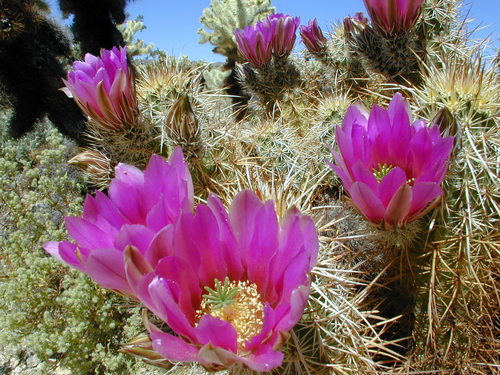


Engelmann'S Hedgehog Cactus
echinocereus engelmannii
Engelmann's Hedgehog Cactus (Echinocereus engelmannii) is one of the most common and striking cacti found in the deserts of the southwestern United States and northwestern Mexico. Known for its dense, colorful spines and vibrant spring blooms, this resilient plant forms low-growing, multi-stemmed clumps that hug the arid landscape. It plays a vital role in desert ecosystems, providing food and shelter for various local wildlife. In late spring, these hardy clusters erupt into a spectacular display of large, funnel-shaped flowers ranging from bright magenta to rich pinkish-purple, contrasting beautifully with the harsh, dry environment.
Habitat: Typically found growing in dry, rocky or sandy soils of the Sonoran and Mojave Deserts, often on gravelly alluvial fans, rocky hillsides, and canyon slopes.
This cactus features cylindrical green stems growing in tight clusters of up to 60, typically reaching heights of 10 to 30 cm. The stems are heavily covered in stout, interlocking spines that vary in color from yellow and brown to grey or red. In spring, it produces large, showy, funnel-shaped magenta flowers up to 9 cm wide with distinctive bright green stigmas at their centers. These flowers are followed by small, spiny, reddish-orange fruits that lose their spines as they ripen.
Category
PlantsRarity
Common
Danger
1/5 · Very low
Snaps
2
Indigenous peoples, including the Cahuilla, traditionally collected the sweet, strawberry-flavored fruits to eat raw or dry for storage.
The common name 'Hedgehog Cactus' comes from the spiny, rounded appearance of the individual stems, which resemble small, bristly hedgehops.
The strong, sharp spines of this plant were historically used as natural sewing needles and tattooing tools by Native Americans.
To conserve precious water, this cactus utilizes Crassulacean Acid Metabolism, opening its stomata at night to absorb carbon dioxide while keeping them closed during the hot day.
The heavy, overlapping spine cover deters hungry herbivores and acts as a built-in shade system, reducing the surface temperature of the stems.
Its extensive, shallow root system is designed to rapidly absorb moisture from brief desert rain showers before the water evaporates.
As a photosynthetic plant, it generates its own food using sunlight, carbon dioxide, and water while drawing minerals from the rocky desert soil.
Ovis canadensis nelsoni
Feeds on the sweet, fleshy red fruits and sometimes the stems during extreme drought.
Apis mellifera
Frequently visits the large magenta flowers for nectar and pollen, acting as a primary pollinator.

Campylorhynchus brunneicapillus
Builds protective nests within the heavily spined branches of the cactus clumps to deter predators.
No trait badges are assigned for this object yet.
No aliases listed yet.
Collections for this object will appear here as more themes are added.
Danger
1/5 · Very low
No special safety notes yet.
The easiest way to identify Engelmann'S Hedgehog Cactus is to use the Snappit nature identifier app.
10-30 cm
1-15 kg
20-50 years
As a photosynthetic plant, it generates its own food using sunlight, carbon dioxide, and water while drawing minerals from the rocky desert soil.
Typically found growing in dry, rocky or sandy soils of the Sonoran and Mojave Deserts, often on gravelly alluvial fans, rocky hillsides, and canyon slopes.
Zoom in to split clusters and explore where this object has been snapped.

Arizona, US
You might spot Northern Cardinal, Engelmann's Hedgehog Cactus, and Queen.
View guide →

Nevada, US
You might spot Engelmann's Hedgehog Cactus.
View guide →

California, US
You might spot Frémont's Phacelia and Devil's Spineflower.
View guide →

Arizona, US
You might spot Saguaro and Graham's Nipple Cactus.
View guide →

California, US
You might spot Western Joshua Tree and Engelmann's Hedgehog Cactus.
View guide →
Take the discovery with you
Snap it with Snappit to identify it, learn what makes it special, and add the discovery to your collection.











.jpg&width=800)



_001.jpg&width=800)




