.jpg&width=800)





Eurasian Hummingbird Hawkmoth
Macroglossum stellatarum
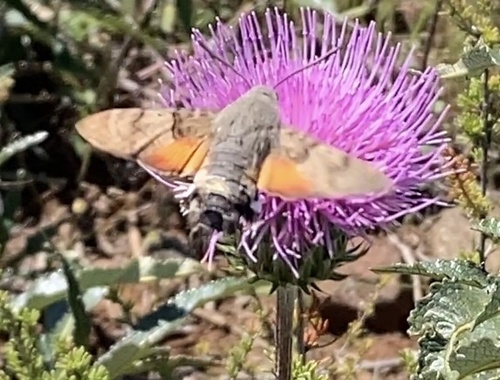
The Eurasian Hummingbird Hawkmoth is a special insect that looks like a tiny hummingbird! It flits around flowers, sipping nectar with its long tongue, just like a bird.
Habitat: Gardens and meadows
The Eurasian Hummingbird Hawkmoth has tawny-brown forewings and bright orange-yellow hindwings, with a distinct black and white checkered abdomen. It possesses a long, slender proboscis and large eyes, giving it a bird-like appearance distinct from most moths.
Category
InsectsRarity
Common
Danger
1/5 · Very low
Snaps
1
It's a champion traveler, migrating hundreds of miles each year!
Its caterpillars munch on plants called bedstraw, then turn into moths!
This amazing moth can remember the best flowers from day to day!
You might hear a soft humming sound as it zips past you!
Eurasian Hummingbird Hawkmoth can hover perfectly still in mid-air because of its incredibly fast wing beats, allowing it to feed precisely.
Eurasian Hummingbird Hawkmoth has a very long proboscis that helps them reach nectar deep inside flowers that other insects cannot access.
Eurasian Hummingbird Hawkmoth can fly and feed during the day because of its sharp vision, making it unique among most moths.
This moth sips sweet nectar from flowers using its super long straw-like tongue!
Age differences: Larvae feed on bedstraw plants before becoming nectar-sipping adults.

Lonicera periclymenum
Helps transfer pollen while collecting nectar.
Galium verum
Caterpillars feed on its leaves before pupating.
Myotis myotis
Adult moths can become a food source for bats.
Phlox paniculata
Visits these flowers for nectar, aiding reproduction.
Colorful describes organisms or objects displaying a wide range of bright and distinct colors.
This trait characterizes organisms whose diet consists entirely or primarily of plant material.
Describes plants that are particularly attractive and beneficial to a wide range of pollinating organisms.
Diurnal animals are primarily active during daylight hours, typically resting or sleeping at night.

Pertaining to species that are significantly smaller than typical or average for their kind.

This trait identifies organisms that exhibit exceptional swiftness in movement for hunting, escape, or travel.

This habitat trait indicates species that can coexist with humans in urban and suburban environments, utilizing man-made structures and green spaces.

Describes organisms that transfer pollen, enabling the fertilization and reproduction of plants.
No aliases listed yet.
Danger
1/5 · Very low
These moths are not harmful, but it's best to watch them from a distance.
The easiest way to identify Eurasian Hummingbird Hawkmoth is to use the Snappit nature identifier app.
40-50 mm
30-35 mm
20-180 days
48 km/h
This moth sips sweet nectar from flowers using its super long straw-like tongue!
Gardens and meadows
Foraging
Zoom in to split clusters and explore where this object has been snapped.
May 7, 2026
Pine Hill Ecological ReservePhoto attribution
(c) Adam J. Searcy, some rights reserved (CC BY)
License: CC BY 4.0 ↗
Image may be shown cropped inside the card frame.
Take the discovery with you
Snap it with Snappit to identify it, learn what makes it special, and add the discovery to your collection.








.jpg&width=800)



