
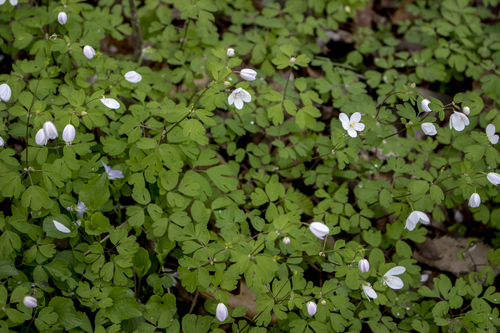


False Rue Anemone
enemion biternatum
The False Rue Anemone (Enemion biternatum) is a delicate, captivating spring ephemeral native to the moist, deciduous forests of eastern and central North America. Blooming vigorously before the forest canopy leafs out, this perennial herb carpets the woodland floor with a brilliant display of star-shaped white flowers. Its ephemeral nature means it completes much of its life cycle in a brief burst of springtime sunshine, capturing the essence of the shifting seasons. While easily confused with other spring wildflowers, the False Rue Anemone holds its own unique charm, often growing in dense, eye-catching colonies that signal the end of winter. It serves as a vital early-season resource for newly emerged woodland insects.
Habitat: Found in moist deciduous woodlands, often thriving in rich soil along shaded stream banks and floodplains.
Growing to a modest height of 10 to 40 centimeters, the False Rue Anemone features smooth, reddish-green, branching stems. Its leaves are biternately compound, meaning they are divided into threes and then divided into threes again, resulting in deeply lobed, delicate green leaflets that closely resemble those of the meadow-rue. The striking flowers span roughly 1.5 to 2 centimeters across and lack true petals; instead, they display exactly five bright white, petal-like sepals surrounding a vivid cluster of yellow stamens at the center. This consistent count of five sepals is the most reliable visual identifier to distinguish it from similar species.
Category
PlantsRarity
Common
Danger
1/5 · Very low
Snaps
Be the first to snap!
Because it blooms so early in the year, it is a crucial pollen source for the very first bees and pollinating flies that emerge from winter dormancy.
Distinguishing the False Rue Anemone from the 'true' Rue Anemone is easy if you count the flower parts: the false version almost always has exactly five petal-like sepals, while the true version can have anywhere from six to ten.
The plant's scientific genus, Enemion, is derived from an ancient Greek name used by Dioscorides for an entirely different plant, reflecting the often tangled history of botanical naming.
It capitalizes on the brief window of early spring sunlight by rapidly blooming and leafing before the forest canopy can block out the sun.
The plant relies on woodland ants to disperse its seeds by attaching a nutrient-rich, fleshy appendage called an elaiosome that ants carry to their nests.
It conserves energy by replacing true petals with modified, colorful sepals that effectively attract pollinators without the extra biological cost.
As a photosynthetic plant, it relies on early spring sunlight to synthesize its own food before the tree canopy closes overhead.
Aphaenogaster rudis
Disperses seeds by feeding woodland ants.
Claytonia virginica
Shares the early spring pollinator pool.

Xylocopa virginica
Serves as an early spring pollen source.
No trait badges are assigned for this object yet.
No aliases listed yet.
Collections for this object will appear here as more themes are added.
Danger
1/5 · Very low
No special safety notes yet.
Start with the whole plant, then compare leaf arrangement, leaf edges, stems and any flowers or fruit. Opposite leaves grow in pairs; alternate leaves come one at a time along the stem. These details tell you far more together than a single green leaf does. Plant Identifier: upload a photo and compare the visible details.
10-40 cm
3-10 years
As a photosynthetic plant, it relies on early spring sunlight to synthesize its own food before the tree canopy closes overhead.
Found in moist deciduous woodlands, often thriving in rich soil along shaded stream banks and floodplains.
Photosynthesis
Zoom in to split clusters and explore where this object has been snapped.
Recent snaps will appear here as new observations are added.

Iowa, US
You might spot False Rue Anemone, Sharp-Lobed Hepatica, and Common Shiner.
View guide →

Indiana, US
You might spot Mayapple, Virginia Springbeauty, and Bloodroot.
View guide →

Illinois, US
You might spot Large White Trillium and Virginia Bluebells.
View guide →

Indiana, US
You might spot Bloodroot, Garlic Mustard, and Eastern Poison Ivy.
View guide →

Indiana, US
You might spot Mayapple, Virginia Springbeauty, and Bloodroot.
View guide →

Iowa, US
You might spot White-Tailed Deer, Jack-In-The-Pulpit, and White Fawnlily.
View guide →
Take the discovery with you
Snap it with Snappit to identify it, learn what makes it special, and add the discovery to your collection.

















