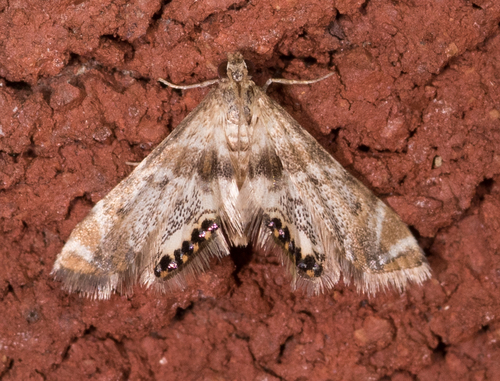


Feather-Edged Petrophila
petrophila fulicalis
The Feather-Edged Petrophila is a fascinating crambid moth renowned for its highly unusual semi-aquatic life cycle. While almost all moths are strictly terrestrial, the larvae of this species live entirely underwater in fast-flowing streams and rivers, spinning protective silk sheets over rocks to anchor themselves. The adults are delicate and beautifully patterned, typically found fluttering close to the water surface or resting on damp riverside rocks. This species represents an incredible evolutionary leap, showcasing how Lepidoptera can adapt to exploit turbulent aquatic niches.
Habitat: Found in and immediately adjacent to clean, fast-flowing freshwater streams and rivers with rocky substrates.
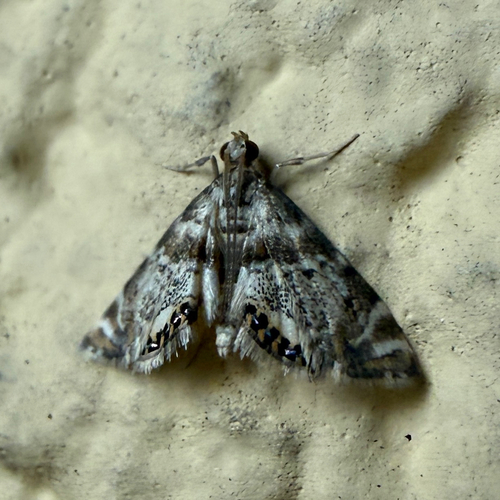
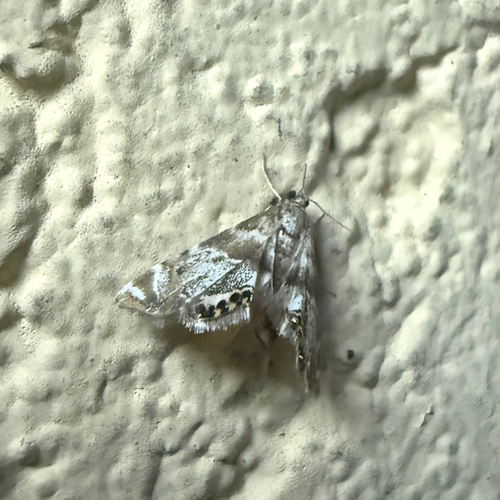
Adults of this species are small, with a wingspan of 1.2 to 1.8 centimeters, exhibiting a complex mosaic of white, brown, and warm golden-orange bands across their wings. The most distinctive feature is a striking row of metallic black and gold spots lining the margin of the hindwings, resembling a delicate, beaded fringe or feather-edged border. When resting, they hold their wings flat in a triangular posture, allowing them to blend seamlessly with lichen-covered river rocks.
Category
InsectsRarity
Common
Danger
1/5 · Very low
Snaps
5
The silk canopy spun by the caterpillar acts like a tiny greenhouse, trapping diatoms and protecting the larva from predators.
This caterpillar spends its entire larval stage underwater, which is an extremely rare trait among moths.
To lay eggs, the female adult moth must submerge herself and crawl down into fast-flowing water to glue eggs to rocks.
The larvae are equipped with filamentous tracheal gills along their bodies, allowing them to extract dissolved oxygen directly from flowing water.
Larvae spin incredibly strong, flat silk canopies over rock surfaces to anchor themselves securely against rapid river currents while feeding.
Adult moths possess highly water-repellent scales on their wings and bodies, enabling them to escape the water surface if submerged during egg-laying.
Larvae are specialized aquatic herbivores that graze on diatoms and algae, while adults do not feed or occasionally sip nectar.
Age differences: Larvae feed exclusively on underwater diatoms and algae, whereas the adult stage relies on stored fat reserves and only occasionally consumes nectar or water.
Acroneuria carolinensis
Larvae are a major food source for predatory aquatic stonefly nymphs in river ecosystems.
Navicula lanceolata
Larvae consume microscopic diatoms on submerged stones, regulating algal growth.

Sayornis phoebe
Adult moths are actively hunted by flycatchers and other insectivorous birds patrolling river banks.
No trait badges are assigned for this object yet.
No aliases listed yet.
Collections for this object will appear here as more themes are added.
Danger
1/5 · Very low
No special safety notes yet.
The easiest way to identify Feather-Edged Petrophila is to use the Snappit nature identifier app.
up to 1 cm
1-2 cm
0.00001-0.00005 kg
8 km/h
Larvae are specialized aquatic herbivores that graze on diatoms and algae, while adults do not feed or occasionally sip nectar.
Found in and immediately adjacent to clean, fast-flowing freshwater streams and rivers with rocky substrates.
Grazing
Zoom in to split clusters and explore where this object has been snapped.
May 8, 2026
Glen Echo ParkPhoto attribution
(c) Carrie Seltzer, some rights reserved (CC BY)
License: CC BY 4.0 ↗
Image may be shown cropped inside the card frame.
Jul 4, 2025
Glen Echo ParkPhoto attribution
(c) Carrie Seltzer, some rights reserved (CC BY)
License: CC BY 4.0 ↗
Image may be shown cropped inside the card frame.
Jun 21, 2024
Glen Echo ParkPhoto attribution
(c) Carrie Seltzer, some rights reserved (CC BY)
License: CC BY 4.0 ↗
Image may be shown cropped inside the card frame.
Take the discovery with you
Snap it with Snappit to identify it, learn what makes it special, and add the discovery to your collection.













.jpg&width=800)




