
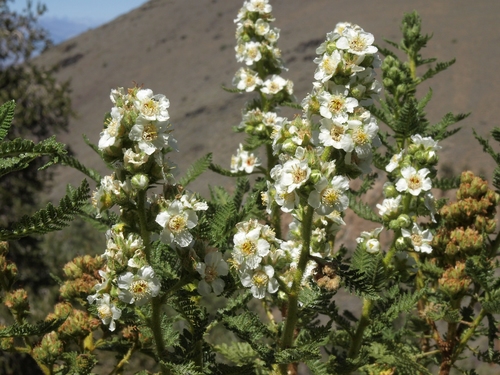


Fernbush
chamaebatiaria millefolium
Fernbush (Chamaebatiaria millefolium), also known as desert sweet or tansy bush, is an exceptionally hardy, aromatic, semi-evergreen shrub native to the arid mountainous regions of western North America. A proud member of the rose family, this resilient plant thrives in dry, rocky conditions where few other shrubs can survive. It plays an important ecological role by stabilizing poor soils, providing vital cover for small desert wildlife, and offering a late-summer nectar source when many other wildflowers have finished blooming.
Habitat: Found on dry, rocky slopes, canyon rims, and volcanic soils within pinyon-juniper woodlands and sagebrush scrub environments.
This upright, rounded shrub typically grows between 90 and 200 centimeters tall. It is characterized by its dense branches covered in olive-green, sticky, deeply-dissected foliage that strongly resembles miniature fern fronds. In mid-to-late summer, the shrub produces erect, branching clusters of small, five-petaled white flowers with prominent yellow centers, closely resembling tiny rose blossoms. After blooming, the flower clusters dry into distinctive, rust-colored seed structures that persist on the branches throughout the winter.
Category
PlantsRarity
Common
Danger
1/5 · Very low
Snaps
Be the first to snap!
Despite its common name and incredibly fern-like leaves, Fernbush is actually a true member of the Rose family.
Native American tribes historically used preparations of the leaves as a traditional remedy for treating colds, bruises, and stomach aches.
The sticky leaves release a strong, highly pleasant scent when bruised that is a unique blend of sage, pine, and citrus.
The foliage is covered in sticky glandular hairs that secrete aromatic resins, protecting the leaves from intense solar radiation and minimizing water loss in arid climates.
It features an expansive root system and semi-deciduous habits, shedding some leaves during severe dry spells to conserve moisture while maintaining survival.
It can withstand extreme temperature fluctuations and sub-zero winter conditions of high-altitude desert plateaus.
As a photoautotrophic plant, Fernbush produces its own food using sunlight, carbon dioxide, and water through the process of photosynthesis.
No trait badges are assigned for this object yet.
No aliases listed yet.
Collections for this object will appear here as more themes are added.
Danger
1/5 · Very low
No special safety notes yet.
Start with the whole plant, then compare leaf arrangement, leaf edges, stems and any flowers or fruit. Opposite leaves grow in pairs; alternate leaves come one at a time along the stem. These details tell you far more together than a single green leaf does. Plant Identifier: upload a photo and compare the visible details.
90-200 cm
20-50 years
As a photoautotrophic plant, Fernbush produces its own food using sunlight, carbon dioxide, and water through the process of photosynthesis.
Found on dry, rocky slopes, canyon rims, and volcanic soils within pinyon-juniper woodlands and sagebrush scrub environments.
Zoom in to split clusters and explore where this object has been snapped.
Recent snaps will appear here as new observations are added.

Idaho, US
You might spot Limber Pine and Dwarf Purple Monkeyflower.
View guide →

Arizona, US
You might spot Elk, Rock Squirrel, and Common Raven.
View guide →

Arizona, US
You might spot Elk, Rock Squirrel, and Common Raven.
View guide →

Arizona, US
You might spot Fernbush, Mat Rock Spiraea, and Baker Kingcup Cactus.
View guide →
Take the discovery with you
Snap it with Snappit to identify it, learn what makes it special, and add the discovery to your collection.


















