.jpg&width=800)





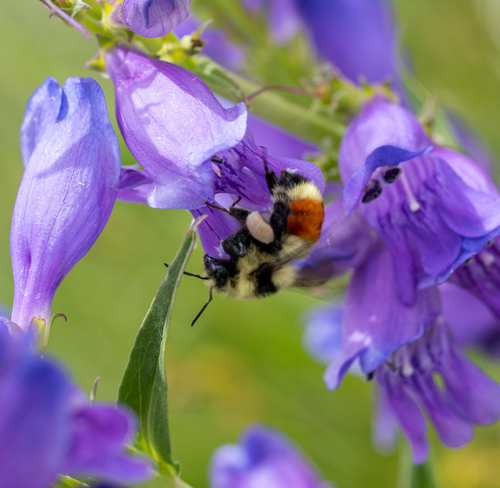
Hunt's Bumble Bee
Bombus huntii
Hunt's Bumble Bee is a fuzzy little bee that loves to buzz around flowers. They are important helpers in nature because they help plants grow by spreading pollen.
Habitat: Grasslands
The Hunt's Bumble Bee is a medium-sized bee distinguished by its bright lemon-yellow and black stripes. It features a prominent rusty or orange-red band across its abdomen, often with a yellow patch towards the tail. Its face is mostly black with some yellow hairs.
Category
InsectsRarity
Common
Danger
2/5 · Low
Snaps
6
Wow! Hunt's Bumble Bees often make their nests underground in abandoned rodent burrows!
Wow! The queen bee can live for about a year, but her worker daughters only live a few weeks!
Wow! They are super important for pollinating crops like blueberries and cranberries!
Wow! Worker bees have special 'pollen baskets' on their legs to carry food back to the hive!
Hunt's Bumble Bee can vibrate its flight muscles without flying, which helps them shake pollen out of specific flowers.
Hunt's Bumble Bee can shiver its body to warm up, allowing it to fly and forage even on cool or cloudy days.
Hunt's Bumble Bee has a long tongue that helps them reach nectar deep inside tubular flowers other bees can't.
Hunt's Bumble Bee can use the sun's position and polarized light to navigate back to its underground nest.
They drink sugary nectar for energy and gather protein-rich pollen to feed their growing bee family.
Helianthus annuus
Gathers nectar and pollen from its flowers.
Cirsium arvense
An important pollinator for this widespread plant.

Trifolium pratense
Feeds on nectar and collects pollen.
Physocephala tibialis
Lays eggs on the bee, and larvae consume it.
Furry describes animals possessing a dense covering of soft hair or fur.
Social animals live in organized groups, cooperating for survival benefits such as foraging, defense, and raising offspring.
Grassland habitats are terrestrial biomes dominated by grasses and herbaceous plants, supporting a variety of grazing animals.
This trait characterizes organisms whose diet consists entirely or primarily of plant material.

Describes plants that are particularly attractive and beneficial to a wide range of pollinating organisms.

Diurnal animals are primarily active during daylight hours, typically resting or sleeping at night.

Describes a species whose presence and role have a disproportionately large effect on its environment.

Describes organisms that transfer pollen, enabling the fertilization and reproduction of plants.
No aliases listed yet.
Danger
2/5 · Low
Be gentle and quiet around bees; they are friendly but can sting if scared.
The easiest way to identify Hunt's Bumble Bee is to use the Snappit nature identifier app.
25-35 mm
9-20 mm
14-365 days
15 km/h
They drink sugary nectar for energy and gather protein-rich pollen to feed their growing bee family.
Grasslands
Foraging
Zoom in to split clusters and explore where this object has been snapped.
Jun 3, 2026
Cheesman ParkPhoto attribution
(c) Bob Walker, some rights reserved (CC BY)
License: CC BY 4.0 ↗
Image may be shown cropped inside the card frame.

Utah, US
You might spot Great White Shark and Gentoo Penguin.
View guide →

Colorado, US
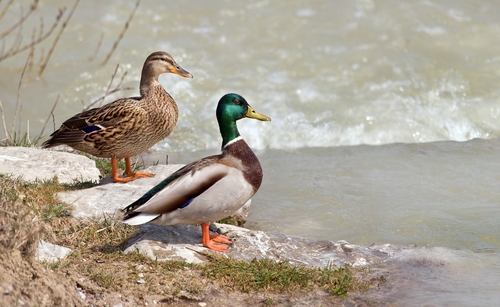
You might spot Eastern Fox Squirrel, Bee, and Duck.
View guide →

Wyoming, US
You might spot Hunt's Bumble Bee and Two-Spotted Bumble Bee.
View guide →

Colorado, US
You might spot Bee, Great Spreadwing, and Duck.
View guide →
Washington, US
You might spot Duck, Yellow-Bellied Marmot, and Canada Goose.
View guide →

Washington, US
You might spot Eastern Gray Squirrel, Yellow-Bellied Marmot, and Duck.
View guide →
Take the discovery with you
Snap it with Snappit to identify it, learn what makes it special, and add the discovery to your collection.





.jpg&width=800)



