
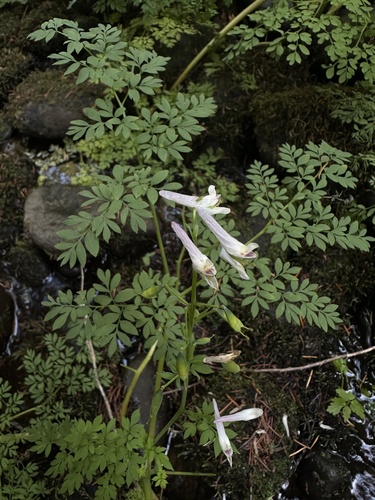


Fitweed
corydalis caseana
Fitweed (Corydalis caseana) is a robust and lush perennial herb native to the mountainous regions of the western United States, most notably the Sierra Nevada. Thriving in wet, shaded environments like stream banks and seeps, it brings a vibrant burst of pale pink to purplish flowers to high-altitude riparian zones during the summer months. Despite its delicate, almost fern-like beauty, it carries a dangerous secret that earned it its common name. The plant is highly toxic to livestock and wildlife due to a potent cocktail of isoquinoline alkaloids. When grazed upon by cattle or sheep, it induces severe neurological symptoms, including tremors, staggering, and violent convulsions known as 'fits'. This fascinating dichotomy of stunning floral displays and potent chemical defenses makes Fitweed a captivating, albeit hazardous, member of the montane flora.
Habitat: Found in wet montane environments, typically thriving along shaded stream banks, in damp mountain meadows, and near cold-water seeps.
Fitweed is a tall, leafy herbaceous plant that can reach up to 1.5 meters (5 feet) in height. It features large, lush, pinnately compound leaves that give it a highly textured, fern-like appearance. In mid-to-late summer, it produces dense, elongated clusters (racemes) of distinctly spurred, tubular flowers that range in color from white to pale pink or purplish. These elongated floral spurs are uniquely designed to accommodate the long tongues of specific pollinators, setting them apart visually from the bowl-shaped flowers typical of most other members of the poppy family.
Category
PlantsRarity
Common
Danger
1/5 · Very low
Snaps
Be the first to snap!
Despite having tubular, spurred flowers that look nothing like traditional poppies, genetic and morphological studies place Fitweed squarely in the poppy family (Papaveraceae).
Fitweed seeds have a tiny, fat-rich attachment that tricks ants into carrying them home; the ants eat the attachment and leave the seed unharmed to grow.
It earned the name 'Fitweed' because grazing animals that eat it suffer from violent convulsions, or 'fits', due to its toxic alkaloids.
Produces potent isoquinoline alkaloids that act as a chemical defense, causing severe convulsions and 'fits' in herbivores that ingest it.
Produces seeds equipped with a nutrient-rich fleshy appendage called an elaiosome that encourages ants to carry the seeds to their nests, facilitating dispersal.
Features elongated floral nectar spurs that restrict nectar access to long-tongued pollinators, ensuring highly targeted and efficient pollination.
Like most plants, Fitweed is an autotroph that creates its own energy through photosynthesis.
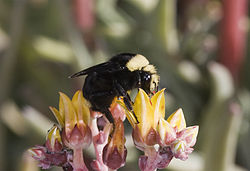
Bombus vosnesenskii
Pollinates Fitweed by reaching into its long nectar spurs.

Formica obscuripes
Disperses seeds by collecting them for their nutritious elaiosomes.
Ovis aries
Suffers from severe neurological poisoning ('fits') if it grazes on the plant.
No trait badges are assigned for this object yet.
No aliases listed yet.
Collections for this object will appear here as more themes are added.
Danger
1/5 · Very low
No special safety notes yet.
Start with the whole plant, then compare leaf arrangement, leaf edges, stems and any flowers or fruit. Opposite leaves grow in pairs; alternate leaves come one at a time along the stem. These details tell you far more together than a single green leaf does. Plant Identifier: upload a photo and compare the visible details.
50-150 cm
3-10 years
Like most plants, Fitweed is an autotroph that creates its own energy through photosynthesis.
Found in wet montane environments, typically thriving along shaded stream banks, in damp mountain meadows, and near cold-water seeps.
Zoom in to split clusters and explore where this object has been snapped.
Recent snaps will appear here as new observations are added.
Take the discovery with you
Snap it with Snappit to identify it, learn what makes it special, and add the discovery to your collection.

















