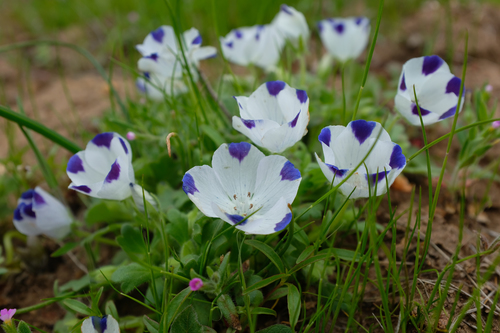


Fivespot
nemophila maculata
The Fivespot (Nemophila maculata) is an enchanting annual wildflower native to the grassy slopes and woodland openings of California. Renowned for its delicate, bowl-shaped flowers, this low-growing plant bursts into a spectacular display in spring, blanketing meadows with a sea of white and purple. It belongs to the borage family and is highly valued by gardeners and native pollinators alike. In the wild, Fivespots thrive in moist soils but are remarkably hardy, adapting to seasonal dry spells by completing their entire lifecycle before the heat of summer peaks. Their friendly, open blooms are not just a visual treat for hikers; they serve as a critical early-season food source for native bees and other beneficial insects, making them a cornerstone of their local woodland ecosystems.
Habitat: Typically found in moist meadows, grassy slopes, and open pine or oak woodlands at elevations up to 1,000 meters.
This low-growing herbaceous plant typically reaches a height of 10 to 30 centimeters, spreading in a gentle carpet-like fashion. Its most striking feature is the flower: a five-petaled, bowl-shaped blossom measuring up to 5 centimeters across, pristine white or pale blue-white, with a distinct, bright royal purple spot on the tip of each petal. Fine purple veins also radiate outward from the yellow-tinted center. The leaves are deeply lobed, light green, and oblong, with a slightly fuzzy texture that helps retain moisture.
Category
PlantsRarity
Common
Danger
1/5 · Very low
Snaps
1
Fivespots are excellent companion plants in vegetable gardens because they attract beneficial predatory insects that feed on pests like aphids.
The distinctive purple spots on the petal tips act like tiny landing pads, signaling to bees exactly where to find nectar.
The scientific genus name 'Nemophila' translates to 'woodland-loving' from Greek, describing the plant's preference for shaded, wooded margins.
Each petal features a prominent purple spot at its tip, which serves as a highly effective ultraviolet and visual 'map' directing pollinators straight to the flower's center.
The plant exhibits a rapid annual lifecycle, germinating, blooming, and setting seed quickly in the spring before the intense California summer heat dries out the soil.
Its flowers track the sun during the morning hours, keeping the reproductive organs warm to encourage higher insect visitation rates.
As a photosynthetic plant, the Fivespot produces its own organic nutrients using energy from sunlight, carbon dioxide from the air, and water and minerals absorbed through its roots.
Andrena
Provides essential early-spring nectar and pollen to native mining bees, which in turn pollinate the flowers.

Odocoileus hemionus
The foliage and seasonal blooms are occasionally browsed by native deer herds moving through foothill habitats.
No trait badges are assigned for this object yet.
No aliases listed yet.
Collections for this object will appear here as more themes are added.
Danger
1/5 · Very low
No special safety notes yet.
Start with the whole plant, then compare leaf arrangement, leaf edges, stems and any flowers or fruit. Opposite leaves grow in pairs; alternate leaves come one at a time along the stem. These details tell you far more together than a single green leaf does. Plant Identifier: upload a photo and compare the visible details.
10-30 cm
0-1 years
As a photosynthetic plant, the Fivespot produces its own organic nutrients using energy from sunlight, carbon dioxide from the air, and water and minerals absorbed through its roots.
Typically found in moist meadows, grassy slopes, and open pine or oak woodlands at elevations up to 1,000 meters.
7-21 days
Zoom in to split clusters and explore where this object has been snapped.
Take the discovery with you
Snap it with Snappit to identify it, learn what makes it special, and add the discovery to your collection.