
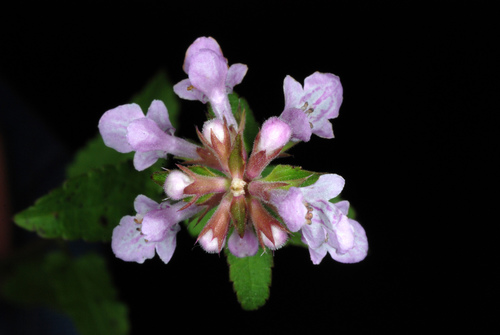


Florida Hedgenettle
stachys floridana
Florida Hedgenettle, also commonly known as Florida betony or rattlesnake weed, is a fascinating perennial herb native to Florida and widespread across the southeastern United States. While often labeled an annoying weed by lawn enthusiasts due to its aggressive growth, it holds a unique place in local ecosystems and wild foraging circles. This member of the mint family reproduces vigorously through an extensive underground network of fleshy, white, segmented tubers that strongly resemble the rattle of a rattlesnake. Above ground, it displays delicate, pale pink to light purple flowers that attract an array of native pollinators. Its resilient nature allows it to thrive in a variety of soils, making it a common sight in disturbed areas, roadsides, and suburban gardens.
Habitat: Typically found in disturbed soils, residential lawns, gardens, roadsides, and the margins of moist pine flatwoods.
This plant grows upright up to 50 cm tall, featuring the classic square stems characteristic of the mint family. Its leaves are oppositely arranged, lance-shaped to ovate, with blunt teeth along the margins. During its blooming period, it produces terminal spikes of small, tubular, two-lipped flowers ranging from pale pink to deep lavender, adorned with darker purple spots on the lower lip. Below the soil lies its most defining visual feature: segmented, stark-white, crisp tubers that look remarkably like rattlesnake tails.
Category
PlantsRarity
Common
Danger
1/5 · Very low
Snaps
Be the first to snap!
Because of its square stems and opposite leaves, it is easily identified as a member of the mint family (Lamiaceae), though it lacks a strong minty scent.
It can regenerate an entire new plant from just a tiny segment of a broken tuber left behind in the soil, making it incredibly difficult to eradicate from gardens.
Its common nickname 'rattlesnake weed' comes from the striking resemblance of its white, segmented tubers to a rattlesnake's rattle.
The crunchy, edible underground tubers have a mild, slightly sweet flavor and a texture resembling water chestnuts.
Stores moisture and nutrients in segmented underground tubers, allowing the plant to survive droughts and regenerate quickly if the foliage is damaged.
Utilizes a rapid underground rhizome network to clone itself and colonize wide areas, outcompeting neighboring groundcover.
Employs highly specialized hooded, two-lipped flowers that provide a landing platform and guide markings to attract efficient bee pollinators.
As a photoautotrophic plant, the Florida Hedgenettle produces its own food by converting sunlight, carbon dioxide, and water into chemical energy via photosynthesis.
Bombus impatiens
Pollinated by bees seeking nectar from the tubular flowers.
Eremochloa ophiuroides
Competes for space, light, and soil nutrients in residential lawn settings.

Odocoileus virginianus
Sometimes browsed by herbivorous mammals in woodland margins.
No trait badges are assigned for this object yet.
No aliases listed yet.
Collections for this object will appear here as more themes are added.
Danger
1/5 · Very low
No special safety notes yet.
Start with the whole plant, then compare leaf arrangement, leaf edges, stems and any flowers or fruit. Opposite leaves grow in pairs; alternate leaves come one at a time along the stem. These details tell you far more together than a single green leaf does. Plant Identifier: upload a photo and compare the visible details.
15-50 cm
2-5 years
As a photoautotrophic plant, the Florida Hedgenettle produces its own food by converting sunlight, carbon dioxide, and water into chemical energy via photosynthesis.
Typically found in disturbed soils, residential lawns, gardens, roadsides, and the margins of moist pine flatwoods.
Photosynthesis
14-28 days
Zoom in to split clusters and explore where this object has been snapped.
Recent snaps will appear here as new observations are added.

Florida, US
You might spot Anole, Eastern Box Turtle, and Golden Silk Spider.
View guide →
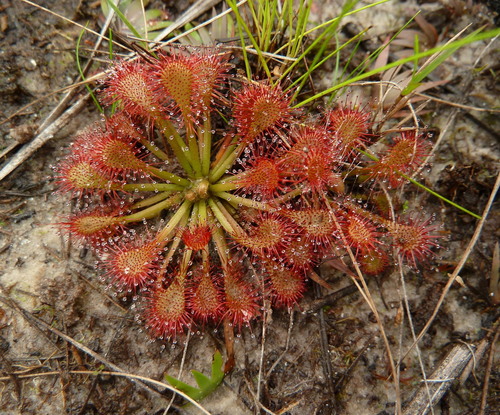
Florida, US
You might spot Pink Sundew, Drooping Forked Fern, and Netted Pawpaw.
View guide →

South Carolina, US
You might spot Gulf Fritillary, Admiral Butterfly, and Cypress Vine.
View guide →
Take the discovery with you
Snap it with Snappit to identify it, learn what makes it special, and add the discovery to your collection.


















