


Fluorite
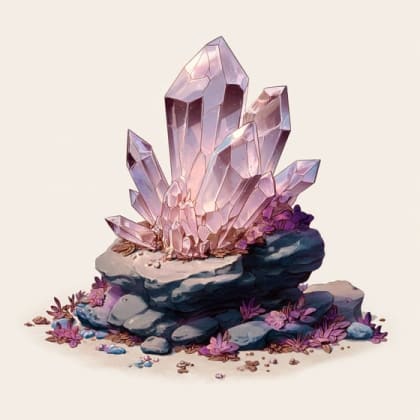
Fluorite is a colorful mineral that comes in many shades like purple, green, and blue. It is often used to make beautiful jewelry and decorations.
The Fluorite is a truly rainbow mineral, often found in vibrant shades of purple, green, blue, and yellow, sometimes even clear. It commonly forms beautiful cubic crystals, which can sometimes appear layered with different colors, making each specimen unique.
Category
MineralRarity
Common
Danger
1/5 · Very low
Snaps
Be the first to snap!
Fluorite gets its name from the Latin word "fluere," meaning "to flow," due to its use as a flux.
It was once carved into fancy cups by ancient Romans, who believed it added a special flavor to drinks!
Some fluorite crystals show "color zoning," where different colored bands grow inside each other like rings.
This mineral is essential for making special lenses in microscopes and telescopes due to its optical properties.
Fluorite can glow brightly under ultraviolet light because it absorbs UV and re-emits it as visible light.
Fluorite has perfect octahedral cleavage, meaning it can split into beautiful eight-sided shapes when hit correctly.
Fluorite helps make strong steel and useful hydrofluoric acid because it contains fluorine, a very reactive element.
Colorful describes organisms or objects displaying a wide range of bright and distinct colors.
Fluorescent minerals emit visible light when exposed to ultraviolet light or other non-visible radiation, a phenomenon called fluorescence.
A gemstone is a piece of mineral crystal which, when cut and polished, is used to make jewelry or other adornments.
Crystalline describes a mineral or rock composed of crystals, often exhibiting a regular atomic structure and geometric external form.

A fossil is the preserved remains or traces of an ancient organism embedded in rock or other geological deposits.
Danger
1/5 · Very low
Fluorite is safe to handle, but it's best to wash your hands after touching it.
The easiest way to identify Fluorite is to use the Snappit nature identifier app.
purple, green, blue, yellow, pink, clear
4
vitreous
3.18
cubic
Zoom in to split clusters and explore where this object has been snapped.
Recent snaps will appear here as new observations are added.
Take the discovery with you
Snap it with Snappit to identify it, learn what makes it special, and add the discovery to your collection.