

Giant Fennel
ferula communis
The Giant Fennel is a striking, herbaceous perennial plant that commands attention in the Mediterranean landscape. Despite its common name, it is not the edible culinary fennel, but rather a toxic relative that grows to towering heights. Historically steeped in mythology, this majestic plant is famously associated with the Greek titan Prometheus, who allegedly smuggled fire from Mount Olympus to humanity hidden inside its thick, hollow stem. In the spring, Giant Fennel transforms dry hillsides into spectacular golden vistas, producing massive umbrella-like flower clusters that attract a variety of pollinators. It survives harsh Mediterranean summers by dying back to its robust underground root system.
Habitat: Found in dry, sunny Mediterranean scrublands, rocky slopes, pastures, and disturbed roadsides.
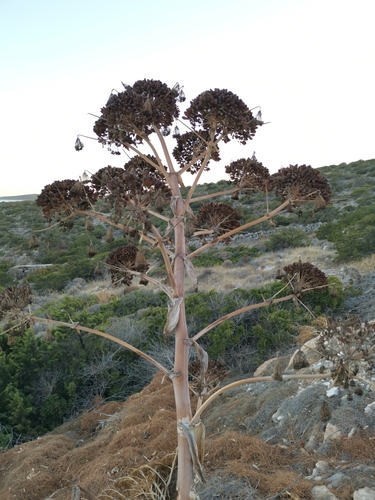
This plant is instantly recognizable due to its immense size, often reaching heights of 200 to 400 centimeters. It features thick, robust, erect stems that are finely ribbed and green, which support highly dissected, feathery, dark green foliage. The most eye-catching feature is its massive inflorescence, consisting of dozens of compound, bright yellow flower heads clustered together in a large dome resembling a golden parasol.
Category
PlantsRarity
Common
Danger
1/5 · Very low
Snaps
Be the first to snap!
Despite its resemblance to culinary fennel, the Giant Fennel is highly toxic to livestock, causing a lethal bleeding disorder known as ferulism.
In Greek mythology, Prometheus stole fire from the gods and smuggled it to humanity inside the slow-burning, dry, pithy stem of a Giant Fennel.
Its dried, lightweight stems were historically used in the Mediterranean to make walking sticks, splints for broken limbs, and light furniture.
It utilizes a massive, fleshy taproot that stores water and nutrients, enabling it to survive dry Mediterranean summers when the above-ground plant dies back.
It produces toxic coumarin compounds that deter grazing herbivores, preventing animals from feeding on its lush spring growth.
It channels stored underground energy to grow up to four meters tall in just a few weeks, easily outcompeting neighboring vegetation for sunlight.
As a photosynthetic plant, the Giant Fennel synthesizes its own food using sunlight, carbon dioxide, and soil nutrients.
Papilio hospiton
The endangered Corsican Swallowtail butterfly uses this plant as a primary larval host for its caterpillars.
Pleurotus eryngii var. ferulae
A highly prized edible mushroom grows specifically on the decaying roots of the Giant Fennel.
Apis mellifera
Honey bees frequently visit the abundant, nectar-rich yellow flowers of the Giant Fennel for foraging.
No trait badges are assigned for this object yet.
No aliases listed yet.
Collections for this object will appear here as more themes are added.
Danger
1/5 · Very low
No special safety notes yet.
Start with the whole plant, then compare leaf arrangement, leaf edges, stems and any flowers or fruit. Opposite leaves grow in pairs; alternate leaves come one at a time along the stem. These details tell you far more together than a single green leaf does. Plant Identifier: upload a photo and compare the visible details.
200-400 cm
5-15 years
As a photosynthetic plant, the Giant Fennel synthesizes its own food using sunlight, carbon dioxide, and soil nutrients.
Found in dry, sunny Mediterranean scrublands, rocky slopes, pastures, and disturbed roadsides.
Zoom in to split clusters and explore where this object has been snapped.
Recent snaps will appear here as new observations are added.
Take the discovery with you
Snap it with Snappit to identify it, learn what makes it special, and add the discovery to your collection.