

Gravel Ghost
atrichoseris platyphylla
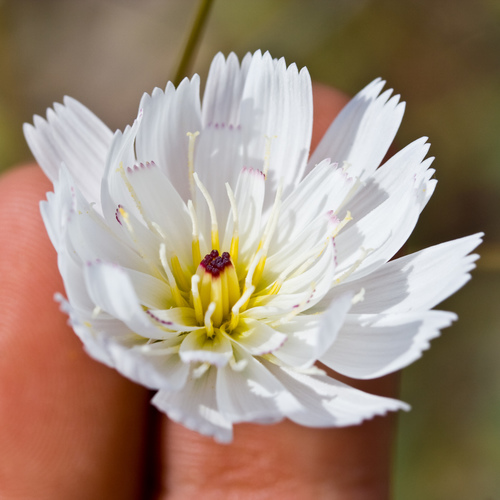
The Gravel Ghost (Atrichoseris platyphylla) is a fascinating annual wildflower native to the arid desert regions of the southwestern United States and northwestern Mexico. Belonging to the sunflower family, this resilient plant has perfected the art of desert survival and camouflage. It gets its evocative common name from the way its pale, spindly, and highly branched stems seem to vanish against the background of desert gravel. This creates the striking optical illusion of white, dandelion-like flower heads floating mysteriously in mid-air, like tiny desert ghosts. Adapted to extremely harsh, dry environments, the Gravel Ghost completes its life cycle quickly during the spring, relying on a robust taproot and specialized water-conserving leaves. For nature enthusiasts exploring desert washes and gravel flats, spotting this plant is a delightful reward that highlights the clever and beautiful evolutionary adaptations of desert flora.
Habitat: Found in dry, open desert washes, gravelly flats, and sandy slopes at elevations below 1,000 meters.
This plant is easily identified by its distinctive basal rosette of broad, flat, tongue-shaped leaves that hug the ground. These leaves are a dull gray-green to purplish color, heavily mottled with darker spots and resembling the surrounding desert pebbles. Rising from this base are nearly leafless, pale green to white, highly branched stems that can reach heights of 10 to 100 centimeters. The flowers, which bloom from February to May, are white to pale pink, fragrant, and resemble dandelions, measuring about 2 to 5 centimeters across with flat, square-tipped petals.
Category
PlantsRarity
Common
Danger
1/5 · Very low
Snaps
2
The basal leaves are so well-camouflaged against desert pavement that they are nearly impossible to spot until the plant begins to produce its tall flowering stems.
The common name 'Gravel Ghost' refers to the plant's pale, almost invisible stems, which cause the white flower heads to look like they are floating in mid-air.
Unlike many desert plants that have harsh or unpleasant odors, the flowers of the Gravel Ghost have a sweet, pleasant fragrance reminiscent of honey.
The broad basal leaves are mottled with gray, purple, and brown, allowing them to perfectly blend in with surrounding desert pavement and avoid herbivores.
The plant's stems are extremely thin, pale, and nearly leafless, making them virtually invisible against bright desert gravel so that the flowers appear to float.
As a desert annual, it utilizes a rapid spring growth cycle and deep taproot to maximize water intake and produce seeds before the extreme summer heat.
As a photoautotroph, the Gravel Ghost produces its own organic nutrients using sunlight, water, and carbon dioxide through photosynthesis.

Gopherus agassizii
Desert tortoises graze on the low-lying basal leaves for vital hydration and nutrients in early spring.
Apis mellifera
Bees visit the sweet-scented white flowers for nectar and assist in pollination.
No trait badges are assigned for this object yet.
No aliases listed yet.
Collections for this object will appear here as more themes are added.
Danger
1/5 · Very low
No special safety notes yet.
Start with the whole plant, then compare leaf arrangement, leaf edges, stems and any flowers or fruit. Opposite leaves grow in pairs; alternate leaves come one at a time along the stem. These details tell you far more together than a single green leaf does. Plant Identifier: upload a photo and compare the visible details.
10-100 cm
0.01-0.2 kg
1 years
As a photoautotroph, the Gravel Ghost produces its own organic nutrients using sunlight, water, and carbon dioxide through photosynthesis.
Found in dry, open desert washes, gravelly flats, and sandy slopes at elevations below 1,000 meters.
Zoom in to split clusters and explore where this object has been snapped.

California, US
You might spot Frémont's Phacelia and Devil's Spineflower.
View guide →

California, US
You might spot Iodinebush, Yerba Mansa, and Golden Gilmania.
View guide →

California, US
You might spot Desert Holly, Desert Sunflower, and Desert Fivespot.
View guide →
Take the discovery with you
Snap it with Snappit to identify it, learn what makes it special, and add the discovery to your collection.