


Grinnell'S Beardtongue
penstemon grinnellii
Grinnell's Beardtongue is an eye-catching, hardy perennial wildflower native to the mountains of Southern California and the southern Sierra Nevada. Thriving in sandy, rocky soils, it often colonizes open spaces, pine forests, and chaparral zones. This plant belongs to the massive genus Penstemon, which is famous for its tube-shaped flowers. What makes Grinnell's Beardtongue particularly beloved by hikers is its robust nature and the sheer abundance of its blossoms, which put on a spectacular display in early summer. It plays a critical role in its native montane ecosystems, offering a rich source of nectar when many other spring wildflowers have already faded. Its resilience against dry, high-altitude conditions highlights the incredible adaptability of California's native flora.
Habitat: Found on dry, rocky or sandy slopes within yellow pine forests, chaparral, and montane scrub communities of Southern California.
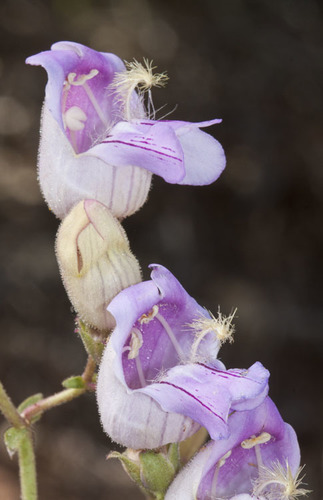
This species is a low, bushy herb growing up to 90 centimeters tall, featuring lance-shaped, grey-green leaves with distinctly toothed margins. The inflorescence consists of wide-mouthed, tubular flowers that range in color from pale lavender to pinkish-white. Inside the gaping throat of each flower are prominent, dark reddish-purple nectar guide lines that point toward the nectar source, as well as a prominent, sterile golden-yellow stamen densely covered in fine hairs, giving it a characteristic 'bearded' appearance. The entire plant, especially the flowering stems, is coated in sticky glandular hairs that glisten under direct sunlight.
Category
PlantsRarity
Common
Danger
1/5 · Very low
Snaps
Be the first to snap!
The common name 'beardtongue' refers to the prominent sterile stamen inside the flower, which is covered in fuzzy golden hairs.
The sticky secretions on the plant's stems function like flypaper, stopping nectar-robbing ants from crawling up the plant.
This species is named in honor of Joseph Grinnell, an influential early 20th-century California zoologist and naturalist.
Uses vivid purple nectar-guide lines inside the flower throat to direct bees and hummingbirds efficiently to its pollen.
Produces sticky hairs on its stems and flowers to deter crawling insect thieves, such as ants, from stealing nectar.
Utilizes a deep taproot and tough, leathery foliage to thrive and flower during dry Mediterranean summers.
As a photosynthetic plant, Grinnell's Beardtongue manufactures its own energy using sunlight, water, and carbon dioxide.

Bombus huntii
Provides a crucial nectar source and is actively pollinated by bumble bees.
Euphydryas chalcedona
Serves as a host plant for caterpillars, which feed on its foliage.

Calypte anna
Attracts hummingbirds looking for rich nectar rewards in montane habitats.
No trait badges are assigned for this object yet.
No aliases listed yet.
Collections for this object will appear here as more themes are added.
Danger
1/5 · Very low
No special safety notes yet.
Start with the whole plant, then compare leaf arrangement, leaf edges, stems and any flowers or fruit. Opposite leaves grow in pairs; alternate leaves come one at a time along the stem. These details tell you far more together than a single green leaf does. Plant Identifier: upload a photo and compare the visible details.
30-90 cm
0.1-0.8 kg
3-10 years
As a photosynthetic plant, Grinnell's Beardtongue manufactures its own energy using sunlight, water, and carbon dioxide.
Found on dry, rocky or sandy slopes within yellow pine forests, chaparral, and montane scrub communities of Southern California.
Zoom in to split clusters and explore where this object has been snapped.
Recent snaps will appear here as new observations are added.
Take the discovery with you
Snap it with Snappit to identify it, learn what makes it special, and add the discovery to your collection.


















