
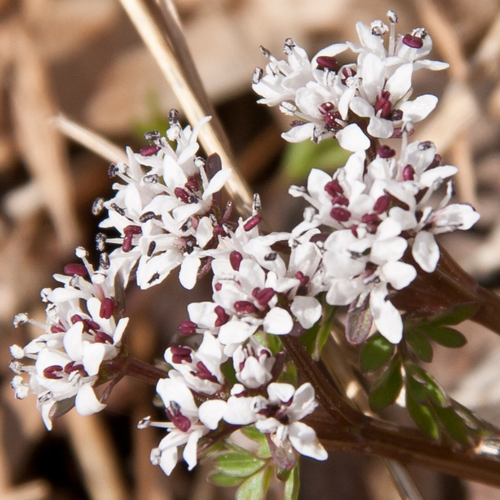


Harbinger Of Spring
erigenia bulbosa
Harbinger of Spring (Erigenia bulbosa) is a tiny, delicate perennial wildflower that serves as one of the very first signs of life on the forest floor after winter. Rising just a few inches above the leaf litter, this beautiful member of the carrot family bursts into bloom in late winter or early spring, often pushing through late-season snows. It is a classic vernal ephemeral, meaning its entire above-ground life cycle—sprouting, flowering, and fruiting—is completed in a fleeting window before the deciduous forest canopy leaves out and blocks the sunlight. This diminutive plant grows from a small, spherical underground tuber which was historically eaten by Native Americans. Because it blooms so early, it provides a crucial, life-saving source of nectar and pollen for the earliest emerging native bees and flies. Encountering this tiny gem during a chilly late-winter walk is a rewarding experience that signals the transition into a warmer, greener season.
Habitat: Found in rich, moist, undisturbed deciduous forests, particularly in floodplains, ravines, and sloping woodlands.
This low-growing wildflower reaches only 5 to 15 centimeters in height, featuring small, intricately divided green leaves that resemble parsley. Its most distinctive feature is the cluster of tiny, star-shaped white flowers arranged in small umbels. Each flower boasts prominent, dark reddish-purple to black anthers that contrast sharply with the white petals, giving the plant its common nickname pepper-and-salt. The stems are reddish-green and smooth, emerging from a small, round underground tuber.
Category
PlantsRarity
Common
Danger
1/5 · Very low
Snaps
Be the first to snap!
It is one of the shortest-lived active plants of the year, spending up to ten months dormant underground as a bulb.
Its underground tuber is edible and has a nutty flavor, which led to another historical common name, 'turkey pea'.
The plant is nicknamed 'pepper-and-salt' because its dark purple anthers resemble black pepper sprinkled over white salt-like petals.
Completes its entire active life cycle in early spring, exploiting the brief window of high sunlight before forest trees grow their leaves.
Possesses specialized cellular compounds that protect its delicate tissues from freezing temperatures, allowing it to bloom amidst snow.
Stores energy in a spherical underground tuber, allowing it to survive dormant underground for most of the year.
Produces its own energy through photosynthesis, utilizing chlorophyll to convert sunlight, carbon dioxide, and water into sugars.
Andrena erigeniae
The specialist bee relies almost exclusively on this plant for early-season pollen and nectar, serving as its primary pollinator.

Odocoileus virginianus
Occasionally grazes on the early foliage, though the plant's small size limits heavy foraging pressure.
No trait badges are assigned for this object yet.
No aliases listed yet.
Collections for this object will appear here as more themes are added.
Danger
1/5 · Very low
No special safety notes yet.
Start with the whole plant, then compare leaf arrangement, leaf edges, stems and any flowers or fruit. Opposite leaves grow in pairs; alternate leaves come one at a time along the stem. These details tell you far more together than a single green leaf does. Plant Identifier: upload a photo and compare the visible details.
5-15 cm
0.002-0.01 kg
3-15 years
Produces its own energy through photosynthesis, utilizing chlorophyll to convert sunlight, carbon dioxide, and water into sugars.
Found in rich, moist, undisturbed deciduous forests, particularly in floodplains, ravines, and sloping woodlands.
Zoom in to split clusters and explore where this object has been snapped.
Recent snaps will appear here as new observations are added.

Ohio, US
You might spot Toadshade, Virginia Springbeauty, and Dutchman's Breeches.
View guide →

Illinois, US
You might spot Eastern Red-Backed Salamander and Harbinger Of Spring.
View guide →
Take the discovery with you
Snap it with Snappit to identify it, learn what makes it special, and add the discovery to your collection.

















