
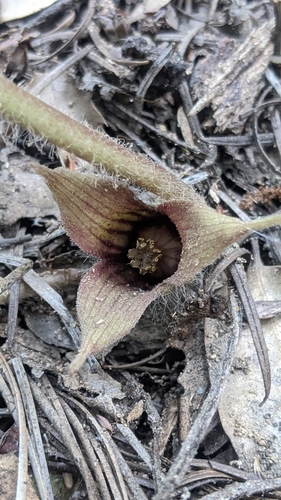


Hartweg'S Wild Ginger
asarum hartwegii
Hartweg's Wild Ginger (Asarum hartwegii) is a captivating perennial herb native to the shady, moist forest floors of Western North America. Despite its common name, it is not a true ginger but belongs to the birthwort family, Aristolochiaceae. This enchanting plant is celebrated for its striking foliage and unique, low-lying flowers that often go unnoticed. Its presence is a delightful indicator of healthy forest ecosystems, contributing to the understory biodiversity with its distinctive appearance and fascinating reproductive strategies.
Habitat: Hartweg's Wild Ginger is typically found in moist, shaded environments of coniferous or mixed evergreen forests, often thriving on nutrient-rich forest floors or along streambanks.
This wild ginger species is easily identified by its distinctive, kidney to heart-shaped leaves, which are typically a dark green adorned with striking silvery-white or light green mottling, creating a marbled effect. The leaves grow in pairs from short stems and can reach up to 15 centimeters in width. Its solitary flowers, often hidden beneath the leaves at ground level, are bell-shaped and a rich purplish-brown or maroon, sometimes described as pitcher-like. The inner surface of the flower may have intricate patterns, adding to its allure.
Category
PlantsRarity
Common
Danger
1/5 · Very low
Snaps
Be the first to snap!
Despite its common name, Hartweg's Wild Ginger is not related to the culinary ginger (Zingiber officinale) but gets its name from the ginger-like aroma of its crushed rhizomes.
Early settlers and indigenous peoples sometimes used the aromatic rhizomes for medicinal purposes, though its safety for consumption is not established.
Its unique, mottled leaves are thought to mimic the appearance of decaying leaf litter, possibly helping it blend into the forest floor and avoid herbivory.
The plant's flowers emit a faint, yeasty or mushroom-like odor, which helps attract the small, ground-dwelling insects responsible for its pollination.
The seeds of Hartweg's Wild Ginger possess a fatty appendage called an elaiosome, which attracts ants. Ants collect the seeds, carry them to their nests, consume the elaiosome, and then discard the viable seed, effectively dispersing it and aiding germination.
Its cryptic, ground-level flowers are designed to attract small flies and gnats, which are temporarily trapped within the flower's bell-shaped structure. This mechanism ensures efficient pollen transfer as the insects navigate out, carrying pollen to other flowers.
This plant exhibits remarkable tolerance for deep shade, a common characteristic of forest understories. Its broad, mottled leaves are efficient at capturing the limited dappled sunlight that penetrates the dense canopy above.
As a photosynthetic plant, Hartweg's Wild Ginger produces its own food by converting light energy into chemical energy. It absorbs carbon dioxide from the air and water and essential nutrients from the soil.
Formica spp.
Seed dispersal via elaiosomes.

Sciaridae spp.
Pollination by attracting small insects.

Various Basidiomycota and Ascomycota
Symbiotic association for nutrient uptake.
Various Gastropoda
Potential herbivory on leaves.
No trait badges are assigned for this object yet.
No aliases listed yet.
Collections for this object will appear here as more themes are added.
Danger
1/5 · Very low
No special safety notes yet.
Start with the whole plant, then compare leaf arrangement, leaf edges, stems and any flowers or fruit. Opposite leaves grow in pairs; alternate leaves come one at a time along the stem. These details tell you far more together than a single green leaf does. Plant Identifier: upload a photo and compare the visible details.
5-15 cm
0.05-0.2 kg
10-20 years
As a photosynthetic plant, Hartweg's Wild Ginger produces its own food by converting light energy into chemical energy. It absorbs carbon dioxide from the air and water and essential nutrients from the soil.
Hartweg's Wild Ginger is typically found in moist, shaded environments of coniferous or mixed evergreen forests, often thriving on nutrient-rich forest floors or along streambanks.
Photosynthesis And Nutrient Absorption
Zoom in to split clusters and explore where this object has been snapped.
Recent snaps will appear here as new observations are added.
Take the discovery with you
Snap it with Snappit to identify it, learn what makes it special, and add the discovery to your collection.


















