

Holmgren'S Buckwheat
eriogonum holmgrenii
Holmgren's Buckwheat (Eriogonum holmgrenii) is a rare, captivating perennial herb native exclusively to the high elevations of the Snake Range in eastern Nevada. Operating as a resilient survivor in one of North America's most challenging alpine environments, this plant forms low, dense mats that cling to rocky, windswept limestone slopes. It represents a marvelous example of localized endemism, having evolved highly specialized traits to thrive in nutrient-poor scree and withstand extreme temperature fluctuations. Its compact growth habit and delicate blooms make it a treasured find for botany enthusiasts exploring the scenic heights of Great Basin National Park. Though small and easily overlooked, it plays a vital stabilizing role in its fragile alpine ecosystem, anchoring loose gravels and providing vital resources for high-altitude pollinators.
Habitat: Found on high-elevation limestone talus slopes, rocky ridges, and gravelly alpine scree fields in subalpine and alpine zones.
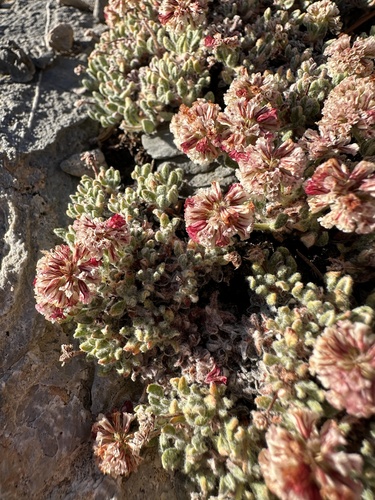
This species is easily recognized by its tight, cushion-like mat growth form, rarely exceeding 10 centimeters in height. Its tiny, oval to spatulate leaves are densely covered in woolly, white-to-greyish hairs, giving the foliage a silvery appearance. During the brief alpine summer, the plant produces compact, head-like clusters of tiny, bell-shaped flowers. These blossoms range in color from creamy white to soft pink, occasionally taking on a yellow or reddish tint as they mature, standing out brightly against the gray limestone talus.
Category
PlantsRarity
Common
Danger
1/5 · Very low
Snaps
Be the first to snap!
Despite living in a freezing environment, the ground-hugging cushion shape can raise the plant's internal temperature several degrees above the surrounding air.
Its thick, hairy leaves act as a natural sunscreen, protecting the delicate plant cells from the intense ultraviolet radiation of high altitudes.
This species is a micro-endemic, meaning it is naturally found nowhere else on Earth outside of a single mountain range in eastern Nevada.
The leaves are densely covered in fine, white hairs that trap a boundary layer of air, reducing moisture loss from harsh winds and reflecting intense solar radiation.
By growing in tight, ground-hugging mats, the plant minimizes exposure to freezing winds and traps radiating heat from the rocks below.
Its deep, woody taproot system penetrates deeply into loose limestone scree, securing the plant against shifting rocks and accessing hidden water pockets.
As a photoautotrophic plant, it synthesizes its own organic compounds using sunlight, carbon dioxide, and water absorbed from the soil.
Euphilotes ancilla
The caterpillars feed on the leaves and flowers of the buckwheat, while the adults assist in pollination.

Bombus huntii
An important alpine pollinator that visits the flowers during the short summer blooming season to gather nectar.
Ochotona princeps
Occasionally harvests the alpine foliage to include in its winter survival haypiles.
No trait badges are assigned for this object yet.
No aliases listed yet.
Collections for this object will appear here as more themes are added.
Danger
1/5 · Very low
No special safety notes yet.
Start with the whole plant, then compare leaf arrangement, leaf edges, stems and any flowers or fruit. Opposite leaves grow in pairs; alternate leaves come one at a time along the stem. These details tell you far more together than a single green leaf does. Plant Identifier: upload a photo and compare the visible details.
1-10 cm
0.01-0.15 kg
10-30 years
As a photoautotrophic plant, it synthesizes its own organic compounds using sunlight, carbon dioxide, and water absorbed from the soil.
Found on high-elevation limestone talus slopes, rocky ridges, and gravelly alpine scree fields in subalpine and alpine zones.
Zoom in to split clusters and explore where this object has been snapped.
Recent snaps will appear here as new observations are added.
Take the discovery with you
Snap it with Snappit to identify it, learn what makes it special, and add the discovery to your collection.