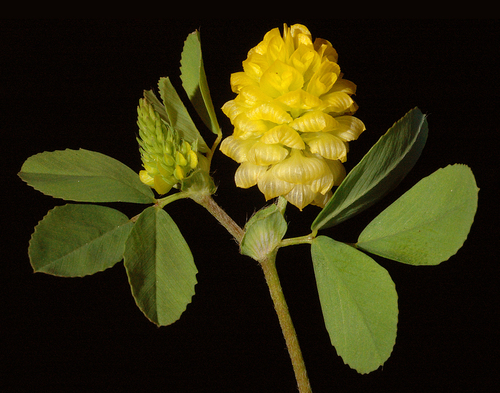


Hop Trefoil
trifolium campestre
Hop Trefoil is a charming annual herbaceous plant belonging to the legume family, Fabaceae. It is widely recognized for its cheerful, bright yellow flower heads that closely resemble miniature hops, which gives the plant its distinctive common name. Native to Europe and Western Asia, this resilient clover has successfully naturalized in many other regions worldwide, including North America and Australia. It plays a valuable ecological role by forming symbiotic relationships with soil bacteria to fix nitrogen, enriching the surrounding soil while providing nutrient-rich forage for livestock and a vital source of nectar for local pollinators.
Habitat: Typically found in open, sunny environments such as dry pastures, grassy fields, roadsides, waste areas, and coastal dunes.
This low-growing plant typically reaches heights of 10 to 30 cm, featuring slender, reddish-brown, hairy stems that can be upright or trailing. Its leaves are alternate and trifoliate, with three small, oblong leaflets; crucially, the central leaflet has a distinct short stalk, separating it from the side leaflets. The tiny, bright yellow flowers are clustered in spherical or egg-shaped heads about 8 to 15 mm wide. As they mature, the flowers turn light brown, dry up, and droop downwards, taking on a papery appearance resembling hops.
Category
PlantsRarity
Common
Danger
1/5 · Very low
Snaps
2
The dried flower heads closely resemble real hops used in beer brewing, which is how it earned its common name 'Hop Trefoil'.
The species name 'campestre' is Latin for 'of the fields', pointing directly to its favorite grassy and meadow habitats.
Unlike many other common clovers where all three leaflets branch from the exact same point, Hop Trefoil's central leaflet has its own distinct petiolule (leaf stem).
Formulates a symbiotic partnership with rhizobia bacteria in its roots, allowing it to convert atmospheric nitrogen into a usable organic form, which enriches the soil.
Produces hardy seeds with a tough outer coat that can remain dormant and viable within the soil seed bank for several years until growing conditions are optimal.
Folds its leaflets together downwards at night to reduce water loss through transpiration and protect delicate surfaces from overnight chill.
As an autotrophic plant, Hop Trefoil produces its own food through photosynthesis using sunlight, carbon dioxide, water, and essential mineral nutrients absorbed from the soil.
Apis mellifera
Provides nectar and pollen to pollinating insects in exchange for pollination.
.jpg&width=800)
Colias philodice
Serves as a larval host plant where caterpillars feed on the leaves.

Trifolium repens
Competes for soil space, light, and nutrients in pastures.
No trait badges are assigned for this object yet.
No aliases listed yet.
Collections for this object will appear here as more themes are added.
Danger
1/5 · Very low
No special safety notes yet.
The easiest way to identify Hop Trefoil is to use the Snappit nature identifier app.
10-30 cm
1 years
As an autotrophic plant, Hop Trefoil produces its own food through photosynthesis using sunlight, carbon dioxide, water, and essential mineral nutrients absorbed from the soil.
Typically found in open, sunny environments such as dry pastures, grassy fields, roadsides, waste areas, and coastal dunes.
Zoom in to split clusters and explore where this object has been snapped.

Georgia, US
You might spot Common Vetch, Tiny Bluet, and Carolina Crane's-Bill.
View guide →

New York, US
You might spot Common Eastern Bumble Bee and American Robin.
View guide →

Georgia, US
You might spot American Beautyberry, Muscadine, and Virginia Creeper.
View guide →

Alabama, US
You might spot Scarlet Calamint and Golden Silk Spider.
View guide →

Georgia, US
You might spot American Beautyberry, Muscadine, and Virginia Creeper.
View guide →
Take the discovery with you
Snap it with Snappit to identify it, learn what makes it special, and add the discovery to your collection.











.jpg&width=800)



_001.jpg&width=800)




