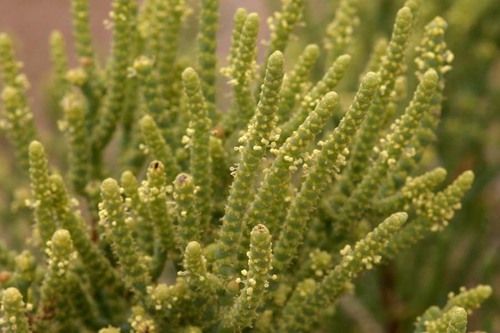


Iodinebush
allenrolfea occidentalis
Iodinebush (Allenrolfea occidentalis) is an extraordinary, highly specialized perennial shrub that thrives where few other plants can survive. Native to the harsh, hyper-saline environments of western North America, this resilient halophyte has adapted perfectly to dry salt flats, desert sinks, and alkaline wetlands. It plays a crucial ecological role by stabilizing vulnerable desert soils, reducing erosion, and providing valuable shelter for specialized desert fauna. Its jointed, succulent stems and unique physiological adaptations make it a fascinating subject for researchers studying extreme plant survival. By safely managing extreme salt concentrations internally, this tough shrub successfully turns desolate, salt-encrusted basins into active, functioning ecosystems, serving as a vital pioneer species.
Habitat: Found in highly saline, alkaline desert soils, salt flats, and coastal salt marshes.
The Iodinebush is a woody shrub growing up to 2 meters tall, instantly recognizable by its succulent, jointed green stems that resemble strings of tiny pickles. The actual leaves are extremely reduced, appearing as minuscule, scale-like structures wrapped tightly around the stem joints. As the plant ages, its stems lose their bright green color and weather to a dark, iodine-like reddish-brown or gray. During its blooming period, it produces tiny, inconspicuous flowers clustered in dense, cylindrical spikes at the ends of its branches.
Category
PlantsRarity
Common
Danger
1/5 · Very low
Snaps
5
The common name Iodinebush comes from the dark reddish-brown, iodine-like color of its dried, weathered woody stems.
The seeds of the iodinebush were historically collected by Native American tribes, who ground them into a nutrient-rich meal.
This plant can grow in soil with salt concentrations that would easily dehydrate and kill almost any other plant species.
Accumulates excess salts inside its fleshy, succulent stem segments to prevent cellular damage, eventually shedding older segments when salt levels become toxic.
Utilizes a highly efficient C4 metabolic pathway to photosynthesize under extreme heat and drought conditions while minimizing water loss.
Lacks traditional flat leaves, reducing its foliage to microscopic scales to dramatically limit water loss via transpiration.
As a photoautotroph, the Iodinebush synthesizes its own sugars using sunlight, carbon dioxide, and saline groundwater.
Reithrodontomys megalotis
Provides crucial nesting cover and habitat for this specialized rodent in salty marshes.
Ellipsoptera nevadica lincolniana
Shades the hyper-saline soils used as critical larval habitat for this highly endangered insect.
No trait badges are assigned for this object yet.
No aliases listed yet.
Collections for this object will appear here as more themes are added.
Danger
1/5 · Very low
No special safety notes yet.
The easiest way to identify Iodinebush is to use the Snappit nature identifier app.
30-200 cm
10-50 years
As a photoautotroph, the Iodinebush synthesizes its own sugars using sunlight, carbon dioxide, and saline groundwater.
Found in highly saline, alkaline desert soils, salt flats, and coastal salt marshes.
Zoom in to split clusters and explore where this object has been snapped.
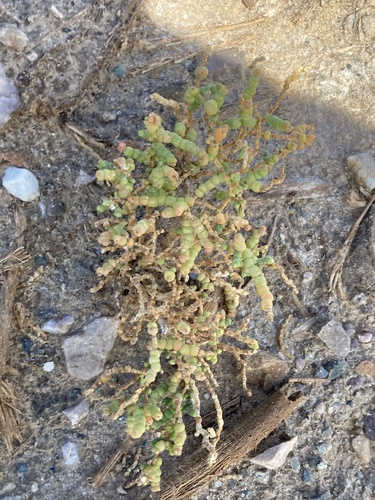
Mar 12, 2023
Eagle Borax WorksPhoto attribution
(c) River Ahlquist, some rights reserved (CC BY)
License: CC BY 4.0 ↗
Image may be shown cropped inside the card frame.
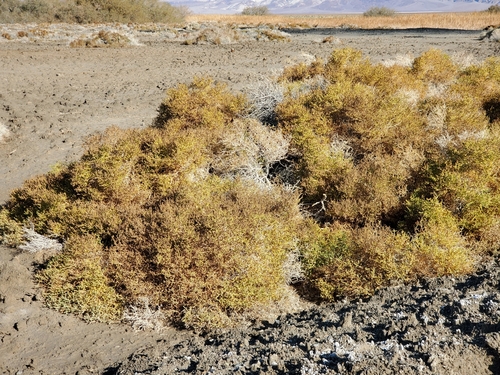
Dec 27, 2019
Eagle Borax WorksPhoto attribution
(c) Bob Miller, some rights reserved (CC BY)
License: CC BY 4.0 ↗
Image may be shown cropped inside the card frame.
Take the discovery with you
Snap it with Snappit to identify it, learn what makes it special, and add the discovery to your collection.












.jpg&width=800)



_001.jpg&width=800)




