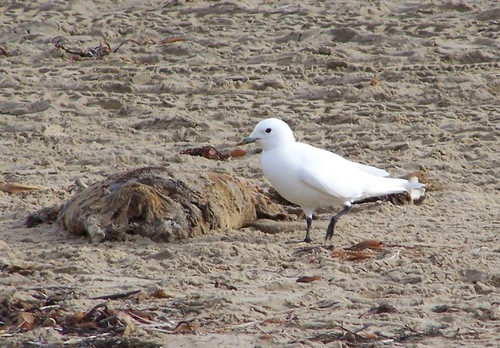


Ivory Gull
pagophila eburnea
The Ivory Gull is a ghostly, breathtakingly beautiful seabird of the High Arctic, immediately recognizable by its pure, snow-white plumage. Inhabiting some of the harshest environments on Earth, this medium-sized gull remains associated with pack ice throughout the year, rarely venturing far south. It is an incredibly resilient species, possessing remarkable adaptations that allow it to thrive where few other birds can survive. Known as a scavenger of the frozen north, the Ivory Gull is famously seen trailing polar bears across the endless ice fields. It feeds opportunistically on seal carcasses, fish, and marine invertebrates. Sadly, this elegant 'ghost of the Arctic' faces significant threats from climate change and melting sea ice, making it an important indicator species for the health of our polar ecosystems.
Habitat: Typically found in the extreme High Arctic, nesting on remote nunataks, gravel cliffs, and rocky islands, while foraging primarily along the edges of pack ice.
Adult Ivory Gulls are entirely pristine white, lacking the grey or black markings typical of other gull species. They have a compact, pigeon-like profile with a relatively small head, short black legs, and dark, large-looking eyes. Their bill is distinctive, showing a slate-blue color at the base that transitions to a yellow or orange tip. Juveniles have a speckled appearance, covered with delicate black spots on their face, wings, and tail, which gradually fade over their first two years. Adults measure about 40 to 45 centimeters in length with a broad, powerful wingspan of roughly 110 centimeters, enabling agile flight in strong polar winds.
Category
BirdsRarity
Common
Danger
1/5 · Very low
Snaps
Be the first to snap!
Because they feed at the top of the Arctic food web via scavenging, they accumulate some of the highest concentrations of mercury and organochlorines of any Arctic bird.
Ivory Gulls often nest on nunataks, which are isolated mountain peaks that project through the surface of glaciers and ice sheets.
They avoid swimming in open water whenever possible, preferring to land on ice floes, frozen ground, or carcasses instead of resting on the ocean surface.
Unlike almost all other gulls, adult Ivory Gulls are entirely pure white, with absolutely no grey, brown, or black feathers on their wings or back.
They possess an exceptionally dense layer of down feathers and specialized blood circulation in their legs to prevent heat loss in freezing Arctic temperatures.
Their pure white plumage provides perfect camouflage against the snow and ice, hiding them from aerial predators like gyrfalcons.
They have developed highly keen eyesight and a superb sense of navigation to locate marine mammal carcasses across vast, featureless ice fields.
The Ivory Gull is an opportunistic carnivore and scavenger, consuming fish, marine invertebrates, and the remains of animals left behind by apex predators.
Age differences: Chicks are fed primarily small fish and marine invertebrates by parents, transitioning to a more opportunistic scavenger diet as they mature.

Ursus maritimus
Following the apex predator to scavenge leftovers from seal kills.

Vulpes lagopus
Preys upon eggs and chicks in nesting colonies.
Boreogadus saida
Actively hunted by the Ivory Gull as a primary marine food source.
No trait badges are assigned for this object yet.
No aliases listed yet.
Collections for this object will appear here as more themes are added.
Danger
1/5 · Very low
No special safety notes yet.
Compare the silhouette, bill shape, tail length, wing bars and markings around the eyes. The same small brown bird at your feeder can look quite different in breeding plumage, winter plumage or its first year. Bird Identifier: upload a photo and compare the visible details.
40+ cm
100+ cm
0.45+ kg
15+ years
60 km/h
The Ivory Gull is an opportunistic carnivore and scavenger, consuming fish, marine invertebrates, and the remains of animals left behind by apex predators.
Typically found in the extreme High Arctic, nesting on remote nunataks, gravel cliffs, and rocky islands, while foraging primarily along the edges of pack ice.
Zoom in to split clusters and explore where this object has been snapped.
Recent snaps will appear here as new observations are added.
Take the discovery with you
Snap it with Snappit to identify it, learn what makes it special, and add the discovery to your collection.