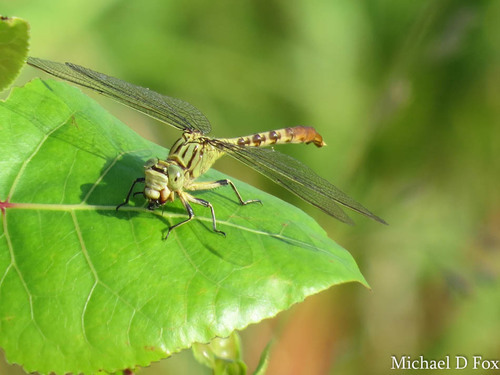


Jade Clubtail
arigomphus submedianus
The Jade Clubtail (Arigomphus submedianus) is an elegant species of dragonfly belonging to the clubtail family, Gomphidae. Common to the central and eastern regions of North America, this insect is a fascinating aerial predator and an excellent indicator of freshwater ecosystem health. Its striking jade-green coloration, contrasted with dark brown or black patterning, makes it a magnificent sight when spotted along the edges of slow-moving rivers and calm lakes. During their early life stages, Jade Clubtails live as aquatic nymphs buried in soft sediment, where they act as fierce ambush predators before emerging to claim the skies. Adults are incredibly agile in flight, utilizing their aerial mastery to capture various flying pests, making them highly beneficial for natural pest control. Their presence near muddy waters adds a vibrant spark of life to riparian habitats, captivating nature enthusiasts and researchers alike.
Habitat: Found near slow-moving muddy rivers, calm lakes, ponds, and sloughs with ample silt or clay substrate.
The Jade Clubtail is a medium-sized dragonfly, ranging from 4.5 to 5.2 centimeters in length with a wingspan between 6 and 8 centimeters. It features a pale, jade-green thorax marked with distinct dark brown stripes, and a dark abdomen decorated with yellow-green spots along its top surface. True to its name, the tip of the abdomen is noticeably swollen or clubbed, especially in males. Its large compound eyes are widely separated across the top of its head, a defining family trait, and they typically shine with a grayish-green or light blue hue in mature individuals.
Category
InsectsRarity
Common
Danger
1/5 · Very low
Snaps
Be the first to snap!
The eyes of clubtail dragonflies do not touch at the top of their heads, which is an easy way to distinguish them from other dragonfly families.
The nymph stage of the Jade Clubtail is much longer than its adult stage, lasting up to several years submerged in mud before emerging for a brief adult life of just a few weeks.
Unlike many other dragonfly species that perch high up on twigs, the Jade Clubtail prefers to rest flat on bare mud or low-lying leaves.
As aquatic larvae, they use specialized, shovel-like forelegs to rapidly burrow into mud and silt to ambush prey and hide from larger predators.
Their widely spaced, massive compound eyes provide a nearly 360-degree field of view, enabling them to detect tiny prey or incoming threats instantly.
They can fly forward, backward, and hover mid-air, transitioning instantly into a high-speed dive to intercept flying insects.
They are carnivorous predators throughout their entire life cycle, consuming aquatic organisms as nymphs and transitioning to flying insects as adults.
Age differences: As aquatic nymphs, they feed on mosquito larvae, small worms, and other water invertebrates; as adults, they feed exclusively on flying insects caught mid-air.

Butorides virescens
Adult clubtails are snatched from low perches or while flying close to the water surface by foraging green herons.
Culex pipiens
Both nymphs and adult clubtails actively hunt and consume mosquito larvae and flying adults, acting as natural population controllers.

Lepomis macrochirus
The aquatic nymphs residing in river sediment are a frequent food source for bottom-feeding bluegills.
No trait badges are assigned for this object yet.
No aliases listed yet.
Collections for this object will appear here as more themes are added.
Danger
1/5 · Very low
No special safety notes yet.
Compare wing shape and resting posture, where the eyes sit, body markings and the tail segments. Males and females can look very different in color. Dragonfly Identifier: upload a photo and compare the visible details.
4-6 cm
6-8 cm
0.001-0.003 kg
1-3 years
30 km/h
They are carnivorous predators throughout their entire life cycle, consuming aquatic organisms as nymphs and transitioning to flying insects as adults.
Found near slow-moving muddy rivers, calm lakes, ponds, and sloughs with ample silt or clay substrate.
Zoom in to split clusters and explore where this object has been snapped.
Recent snaps will appear here as new observations are added.
Take the discovery with you
Snap it with Snappit to identify it, learn what makes it special, and add the discovery to your collection.