

Japanese Climbing Fern
lygodium japonicum
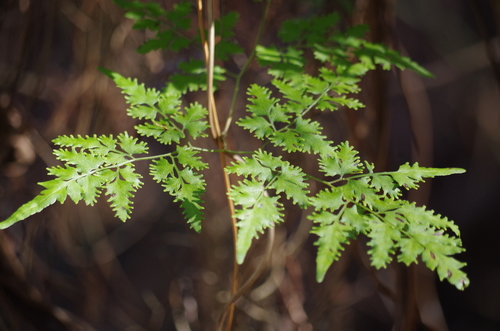
The Japanese Climbing Fern (Lygodium japonicum) breaks all the traditional rules of how a fern should behave. Instead of sprouting in compact, shade-loving clumps on the forest floor, this remarkable plant acts as a climbing vine, sending its lacy fronds up to 30 meters into the canopy to seek out sunlight. Native to eastern Asia, it has earned a reputation as a highly aggressive invasive species in the southeastern United States and Australia. It forms dense, tangled mats that blanket the understory and completely smother native vegetation. What makes it particularly fascinating is its unique anatomy; the 'vine' itself is actually a single, endlessly growing central leaf structure. While undeniably beautiful with its delicate, feathery appearance, it serves as a powerful reminder of how introduced plants can drastically alter ecosystems by outcompeting native flora and dangerously changing fire dynamics in forested habitats.
Habitat: Found in moist woodlands, floodplains, and swamps, often climbing aggressively over understory shrubs and trees.
This species is easily recognized by its delicate, twining, vine-like appearance. Its central 'stem' is actually a rachis (the main axis of a fern frond) that can grow indeterminately, winding tightly around tree trunks, shrubs, and fences. The leaflets are light green and highly divided, giving them a feathery, lacy look. It exhibits dimorphic foliage: the sterile leaflets are broader and lobed, while the fertile leaflets are narrower with distinct finger-like, fringed edges where the rusty-brown, spore-producing sporangia are located. In winter or after a frost, the vines often turn tan or brown, leaving wiry, dead stems still clinging tenaciously to their supports.
Category
PlantsRarity
Common
Danger
1/5 · Very low
Snaps
3
During a forest fire, the dead, dry vines of this fern can act as a 'fire ladder,' carrying ground flames high into the crowns of mature trees that would normally survive low-intensity fires.
To combat its aggressive spread in the southeastern United States, researchers imported and released specialized moths from its native range whose caterpillars exclusively eat the fern.
Unlike most ferns that grow as compact clumps on the forest floor, the Japanese Climbing Fern's fronds act as vines that can climb up to 90 feet high into tree canopies.
What appears to be a long, twining stem is botanically just one single, highly elongated leaf (frond) that never stops growing.
The central axis of the frond functions as a climbing vine and continues to grow indefinitely, allowing the fern to scale tall trees to reach the canopy.
It produces tens of thousands of microscopic spores that can be carried long distances by wind, water, or hitchhiking on animals and human equipment.
The plant survives winter frosts and ground fires by retreating to its creeping underground stems (rhizomes), quickly resprouting when conditions improve.
Like most plants, the Japanese Climbing Fern produces its own food through photosynthesis using sunlight, water, and carbon dioxide.

Pinus palustris
Provides a structural support for the fern's vines to climb towards sunlight, but is often outcompeted or killed as a result.
Neomusotima conspurcatalis
The caterpillar of this moth feeds exclusively on the fern and has been released as a biological control agent in the US.

Sabal palmetto
The fern grows over and smothers the seedlings of these trees, drastically reducing the forest's ability to regenerate.
No trait badges are assigned for this object yet.
No aliases listed yet.
Collections for this object will appear here as more themes are added.
Danger
1/5 · Very low
No special safety notes yet.
The easiest way to identify Japanese Climbing Fern is to use the Snappit nature identifier app.
100-3000 cm
Like most plants, the Japanese Climbing Fern produces its own food through photosynthesis using sunlight, water, and carbon dioxide.
Found in moist woodlands, floodplains, and swamps, often climbing aggressively over understory shrubs and trees.
Zoom in to split clusters and explore where this object has been snapped.
Alabama, US
You might spot Elephantear, Three-Ridge Mussel, and Rough Fatmucket.
View guide →

Georgia, US
You might spot American Beautyberry, Muscadine, and Virginia Creeper.
View guide →

Alabama, US
You might spot Dwarf Palmetto and Sensitive Fern.
View guide →

Georgia, US
You might spot American Beautyberry, Muscadine, and Virginia Creeper.
View guide →

Georgia, US
You might spot Gulf Fritillary, Muscovy Duck, and Canada Goose.
View guide →

Texas, US
You might spot Brown Anole, Japanese Climbing Fern, and Chinese Tallow.
View guide →
Take the discovery with you
Snap it with Snappit to identify it, learn what makes it special, and add the discovery to your collection.












.jpg&width=800)



_001.jpg&width=800)




