





longleaf pine
Pinus palustris
The longleaf pine is a tall tree with long, slender needles that can grow very high. It provides homes for many animals and helps keep the air clean.
Habitat: Forests
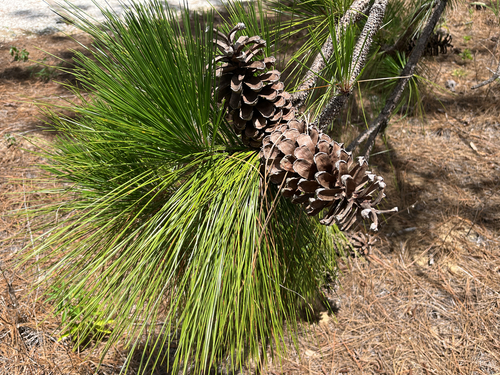
The longleaf pine has incredibly long, dark green needles, bundled in threes, that can grow up to 18 inches. Its straight, sturdy trunk is covered in scaly reddish-brown bark, topped by an open, rounded crown. Large, prickly cones often remain on branches.
Category
PlantsRarity
Common
Danger
1/5 · Very low
Snaps
13
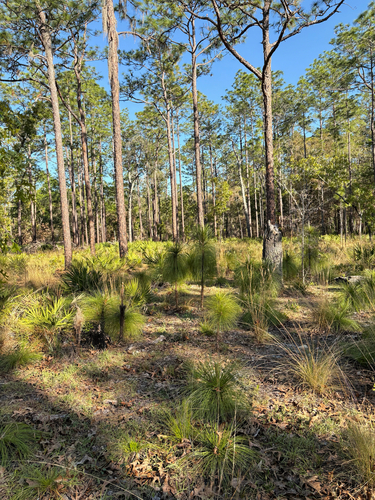
For several years, young longleaf pines look like a patch of grass!
Longleaf pines can live for hundreds of years, making them wise, old forest guardians!
Their incredibly long needles, up to 18 inches, are the longest of any pine species!
These trees once covered 90 million acres of the southeastern United States!
Longleaf pine can withstand frequent fires due to its thick bark and 'grass stage' growth, helping it survive wildfire.
This pine develops a deep taproot to find water and nutrients far underground, making it drought-resistant and stable.
Longleaf pine seeds need bare soil exposed by fire to sprout, ensuring new trees grow in healthy, open environments.
Dryobates borealis
nests in cavities of living pines.

Gopherus polyphemus
relies on open longleaf pine forests.
.jpg&width=800)
Sciurus niger
consumes seeds from longleaf pine cones.
Aristida stricta
co-exists in fire-maintained habitats.
Coniferous plants are typically evergreen, bearing needles or scales and reproductive cones.
Evergreen plants retain their foliage throughout the year, never shedding all their leaves at once.
Timber refers to wood that has been prepared for use in building and carpentry.
This trait signifies organisms belonging to a very old evolutionary group with ancestors dating back millions of years.

Forest habitats are terrestrial environments dominated by dense tree cover, supporting a high diversity of plant and animal life.

This trait characterizes organisms with an exceptionally long lifespan compared to others of their kind.

Describes a species whose presence and role have a disproportionately large effect on its environment.
No aliases listed yet.
Danger
1/5 · Very low
Stay away from the sharp needles and branches when playing near these trees.
The easiest way to identify longleaf pine is to use the Snappit nature identifier app.
3000-4700 cm
600-1200 cm
Spring
No
None
Perennial
Wind
Zoom in to split clusters and explore where this object has been snapped.
May 23, 2026
Bok Tower GardensPhoto attribution
(c) Darren Oh, some rights reserved (CC BY-SA)
License: CC BY-SA 4.0 ↗
Image may be shown cropped inside the card frame.
Apr 21, 2026
Morningside Nature CenterPhoto attribution
(c) Emily Geest, some rights reserved (CC BY)
License: CC BY 4.0 ↗
Image may be shown cropped inside the card frame.

Florida, US
You might spot Atala, Monarch, and Brown Anole.
View guide →

Florida, US
You might spot Anhinga, American Alligator, and Wood Duck.
View guide →

Georgia, US
You might spot Eastern Gray Squirrel, Domestic Cat, and American Robin.
View guide →
Alabama, US
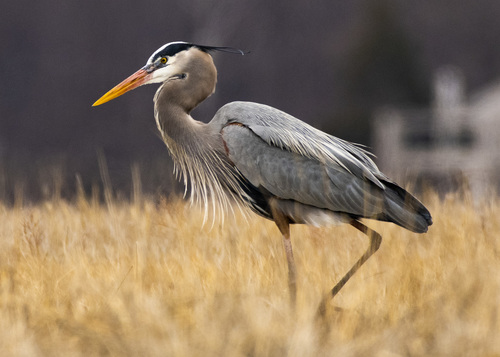
You might spot Great Blue Heron, Brown Pelican, and White Pitcher Plant.
View guide →

Alabama, US
You might spot Eastern Lubber Grasshopper, Christmas Lichen, and Anole.
View guide →

Georgia, US
You might spot Strawberry Bush, Fire Pink, and Red Salamander.
View guide →
Take the discovery with you
Snap it with Snappit to identify it, learn what makes it special, and add the discovery to your collection.








.jpg&width=800)



_001.jpg&width=800)


