_(10391639073).jpg&width=800)





Jumping Gall Wasp
Neuroterus saltatorius
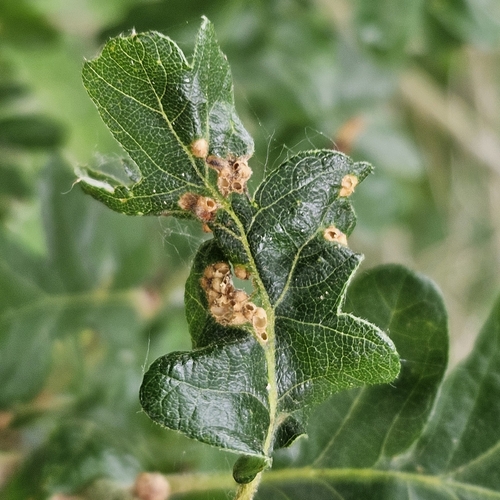
The Jumping Gall Wasp is a tiny insect that makes little galls on oak trees. These galls are like cozy homes for the wasp's babies, and they can jump when they are disturbed!
Habitat: Forests
The Jumping Gall Wasp is a tiny insect, typically dark brown to black, with a compact, ant-like body. Some generations are wingless, while others possess clear, delicate wings. It's often distinguished by its surprisingly powerful hind legs.
Category
InsectsRarity
Common
Danger
1/5 · Very low
Snaps
2
Despite their name, some generations of this wasp cannot fly at all!
Each tiny gall contains a single baby wasp growing safely inside.
They cause oak trees to grow tiny, seed-like galls on their leaves!
They spend most of their life hidden away, tucked inside a leaf gall!
Jumping Gall Wasps can jump surprising distances to evade predators, using their strong, spring-loaded legs.
This wasp induces oak trees to grow unique, seed-like galls that protect and nourish its developing larvae.
Jumping Gall Wasps have two distinct forms in their life cycle: one wingless and jumping, the other winged.
Adults don't eat much, while their young munch on nutrients from oak trees!
Age differences: Larvae consume gall tissue; adults typically do not feed or feed very little.

Quercus lobata
Induces galls on leaves for larval development.
Torymus californicus
Larvae feed on the developing gall wasp larva inside the gall.

Poecile gambeli
Birds peck open galls to eat the wasp larvae inside.
Solitary animals live alone for most of their lives, only interacting with others for mating or parental care.
This trait characterizes organisms whose diet consists entirely or primarily of plant material.
Forest habitats are terrestrial environments dominated by dense tree cover, supporting a high diversity of plant and animal life.
Diurnal animals are primarily active during daylight hours, typically resting or sleeping at night.

Describes a species whose presence and role have a disproportionately large effect on its environment.

Pertaining to species that are significantly smaller than typical or average for their kind.

Describes organisms that transfer pollen, enabling the fertilization and reproduction of plants.
No aliases listed yet.
Danger
1/5 · Very low
It's best to look at insects from a distance and not touch them.
The easiest way to identify Jumping Gall Wasp is to use the Snappit nature identifier app.
2-4 mm
1-2 mm
5-10 days
Adults don't eat much, while their young munch on nutrients from oak trees!
Forests
Null
6
Zoom in to split clusters and explore where this object has been snapped.
May 23, 2026
Berry Botanic GardenPhoto attribution
(c) Tser, some rights reserved (CC BY)
License: CC BY 4.0 ↗
Image may be shown cropped inside the card frame.

Oregon, US
You might spot Duck, Pacific Trillium, and Wood Duck.
View guide →

Oregon, US
You might spot Tree-Of-Heaven, Duck, and Canada Goose.
View guide →

Oregon, US
You might spot Great White Shark, Blue Spotted Stingray, and Octopus.
View guide →
Take the discovery with you
Snap it with Snappit to identify it, learn what makes it special, and add the discovery to your collection.







.jpg&width=800)


