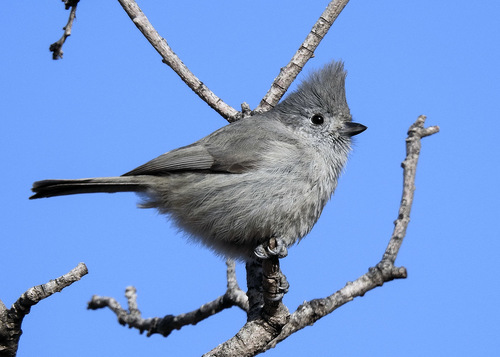


Juniper Titmouse
baeolophus ridgwayi
The Juniper Titmouse is a charming, active little songbird closely tied to the dry, fragrant pinyon-juniper woodlands of the western United States. Marked by its subtle gray plumage and a small, expressive crest, this bird is a lively presence year-round, flitting through the branches in search of insects and seeds. Its rasping, chatter-like calls are a hallmark sound of the high desert plateau. Because they are highly sedentary, a single pair will often defend the same territory throughout their lives, forming a deep and enduring bond with their specific patch of woodland.
Habitat: Found in dry pinyon-juniper woodlands, open pine forests, and arid scrublands of the western United States.
This small, plain songbird is overall monochromatic, colored in soft, uniform shades of brownish-gray on its back and a slightly paler gray below. It features a distinct, pointed crest on its head that it can raise or lower depending on its alertness. Its dark eyes stand out against its unmarked, plain face, and it possesses a short, stout, dark bill ideal for cracking seeds. It is visually almost identical to the Oak Titmouse but is distinguished by its cooler gray tones and its specific habitat.
Category
BirdsRarity
Common
Danger
1/5 · Very low
Snaps
2
Juniper Titmouses are strictly non-migratory, with mated pairs often defending the same small territory for their entire lives.
They line their nests with incredibly soft materials, often searching out mammal fur, wool, feathers, and even shed snake skins.
Until 1996, the Juniper Titmouse and the Oak Titmouse were considered a single species known as the Plain Titmouse.
They possess an exceptional spatial memory, allowing them to hide thousands of juniper seeds and pine nuts in bark crevices and relocate them months later during harsh winters.
These birds are incredibly agile, frequently hanging completely upside down from the tips of twigs to inspect the undersides of leaves and cones for hidden insects.
They use complex, scratchy alarm calls to communicate specific threat levels to their mates and neighboring birds in the dense woodland canopy.
Feeds heavily on insects and spiders during the summer breeding season, shifting to a diet dominated by seeds and juniper berries during the winter.
Age differences: Nestlings are fed an exclusive diet of high-protein insects and caterpillars before transitioning to seeds and berries as they fledge.

Juniperus osteosperma
Eats and disperses the seeds, aiding in the reproduction and spread of this desert evergreen.
Pinus edulis
Caches the large seeds in bark crevices, occasionally forgetting them which allows new pine seedlings to grow.

Accipiter striatus
A small woodland raptor that preys upon small passerines, including the titmouse.
No trait badges are assigned for this object yet.
No aliases listed yet.
Collections for this object will appear here as more themes are added.
Danger
1/5 · Very low
No special safety notes yet.
The easiest way to identify Juniper Titmouse is to use the Snappit nature identifier app.
13+ cm
20+ cm
0.013+ kg
2+ years
25 km/h
Feeds heavily on insects and spiders during the summer breeding season, shifting to a diet dominated by seeds and juniper berries during the winter.
Found in dry pinyon-juniper woodlands, open pine forests, and arid scrublands of the western United States.
Zoom in to split clusters and explore where this object has been snapped.

New Mexico, US
You might spot Tree Cholla, Colorado Pinyon, and House Finch.
View guide →

Colorado, US
You might spot Common Side-Blotched Lizard and Eastern Collared Lizard.
View guide →
Take the discovery with you
Snap it with Snappit to identify it, learn what makes it special, and add the discovery to your collection.







.jpg&width=800)









