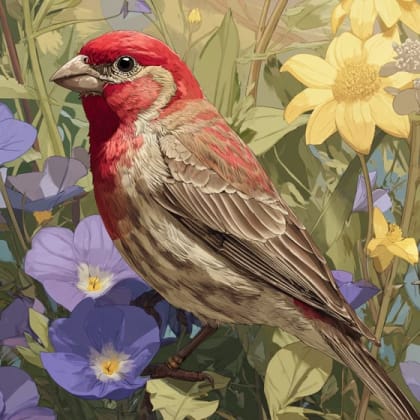





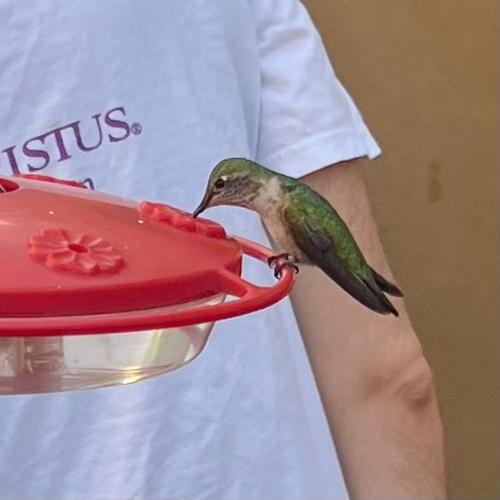
House Finch

Step into Santa Fe's storied past at the Barrio de Analco, one of the oldest residential neighborhoods of European origin in the United States.
Step into Santa Fe's storied past at the Barrio de Analco, one of the oldest residential neighborhoods of European origin in the United States. A National Historic Landmark District, this captivating area offers an unparalleled glimpse into centuries of cultural evolution, where Spanish, Indigenous, and American influences beautifully converge in its distinctive architecture and enduring spirit. Its narrow, intimate adobe-lined streets tell tales of early colonial life, making it a unique open-air museum.
The district's heart features iconic landmarks such as the San Miguel Chapel, often considered the oldest church building in the continental United States, and the legendary "Oldest House" (De Vargas Street House), whose foundations hint at an even more ancient past. Visitors can explore the preserved Spanish Pueblo and Territorial architectural styles evident in residences like the Roque Tudesqui House, Gregorio Crespin House, and Boyle House, characterized by thick adobe walls, exposed wooden vigas, and unique interior details like corner fireplaces. These structures showcase the adaptive building techniques and cultural blending that defined early New Mexico.
A visit to the Barrio de Analco Historic District is an immersion into the very soul of Santa Fe, offering more than just historical facts; it provides an evocative atmosphere that transports you to a bygone era. It's a place where history resonates in every adobe brick and winding path, inviting contemplation and discovery. The district’s commitment to preserving its architectural heritage and telling the stories of its diverse inhabitants makes it an unforgettable destination for those seeking a deeper connection with the American Southwest. Enhance your adventure: download the Snappit app to identify the local species you encounter.
The Barrio de Analco was established by the Spanish in 1620, shortly after the founding of Santa Fe. Its name, derived from the Nahuatl word "Analco," meaning "the other side of the water," refers to its location across the Santa Fe River from the main plaza where Spanish officials resided. This area was originally settled by working-class Spanish colonists, Tlaxcalan people (Indigenous allies who accompanied the Spanish from Mexico), and other Native Americans. Life in the barrio was significantly disrupted during the Pueblo Revolt of 1680, when Puebloan people rebelled against Spanish rule, leading to the destruction of much of the district, including the San Miguel Chapel. However, the Spanish recolonized New Mexico in 1692, and the Barrio de Analco was subsequently rebuilt, continuing its role as a vital residential and artisan community. Over centuries, the buildings evolved to reflect a blend of Spanish Pueblo and later Territorial architectural styles, incorporating Indigenous and American building techniques into the traditional adobe construction. The district was recognized as a National Historic Landmark in 1968.
Take a self-guided walking tour to appreciate the unique architecture, learn about the lives of early inhabitants, and photograph the historic streetscapes. Many buildings have informational plaques.
Santa Fe experiences hot summers (July-August) and cold, sometimes snowy winters (December-February). Spring (April-May) and Fall (September-October) are generally mild and sunny, making them excellent for outdoor exploration.
As a historic district with older infrastructure, sidewalks may be uneven, and some historic buildings might have limited wheelchair access due to their age and preservation status. The area is generally walkable.
Often cited as the oldest church building in the continental U.S., with its historic altar screen, bulto of St. Michael, and the San José bell.
A two-story adobe structure with sections potentially dating back to pre-Spanish Pueblo architecture, offering a glimpse into early colonial and Indigenous building methods.
Observe the evolution of Spanish Pueblo and Territorial architectural styles in the preserved residences along De Vargas Street and surrounding areas.
An imposing adobe Territorial style building with a rich history related to St. Michael's College.
Each card links to a full Explore page with photos, traits, and fun facts.
Start with the big picture, then zoom in to explore individual wildlife observations around this place.
Wear comfortable shoes suitable for walking on uneven surfaces and sidewalks.
Bring a camera to capture the unique adobe architecture and historic street scenes.
Allow ample time to wander the side streets, where you might discover hidden courtyards or architectural details.
Consider visiting the interiors of the San Miguel Chapel and the "Oldest House" for a deeper historical perspective.
Parking can be limited in the immediate vicinity; consider walking from the Santa Fe Plaza or other nearby parking areas.
Look for historical markers and interpretive signs that provide context and stories about the district's past.

Maryland, US
You might spot White-Tailed Deer and Eastern Gray Squirrel.
View guide →
.jpg)
District of Columbia, US
You might spot Eastern Gray Squirrel, Duck, and House Sparrow.
View guide →

Illinois, US
You might spot American Robin, Canada Goose, and House Sparrow.
View guide →

Virginia, US
You might spot Spotted Lanternfly and Northern Cardinal.
View guide →
Take the discovery with you
Identify the wildlife you spot, learn as you go, and keep a collection of the adventure.





























_(19730267073).jpg&width=800)
