

Kite-Tailed Robberfly
tolmerus atricapillus
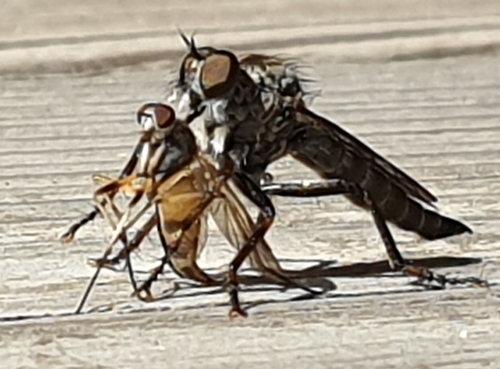
The Kite-Tailed Robberfly (Tolmerus atricapillus) is a highly efficient predatory insect belonging to the robberfly family, Asilidae. Renowned for its spectacular aerial hunting skills, this medium-sized fly spends much of its time perched on sunny leaves or fence posts, scanning the environment with its large, sensitive compound eyes. Once it spots an insect flying nearby, it launches with rapid speed to ambush and intercept its prey mid-air, gripping it securely with strong, bristled legs. It plays an important role in controlling agricultural and garden pest populations, making it an ecologically valuable species.
Habitat: Found along sunny woodland edges, clearings, hedgerows, and overgrown grassy fields where low perches are abundant.
This species measures between 1.2 to 1.8 cm in length, featuring a slender, dusty-gray to brown body covered in fine hairs. It is identified by its large, bulging dark eyes separated by a dense cluster of bristles on its face, known as a mystax. Its legs are robust, dark, and armed with prominent spines, with a characteristic reddish-brown band near the base of the tibiae. The wings are translucent with distinct veins and lie flat over the abdomen when perched. The common name arises from the elongated, wedge-like shape of the terminal abdominal segments, which resemble a tiny kite.
Category
InsectsRarity
Common
Danger
1/5 · Very low
Snaps
Be the first to snap!
Despite their intimidating appearance and venomous bite used on prey, they are completely harmless to humans and will only bite if handled very roughly.
Kite-Tailed Robberfly larvae are underground predators that actively tunnel through soil to hunt for beetle grubs and grasshopper eggs.
The bristly 'mustache' on a robberfly's face, called a mystax, is actually a shield that protects its eyes from the thrashing legs of struggling prey.
Calculates the intercept path of moving prey mid-flight to capture them rapidly, rather than simply chasing them from behind.
Injects a potent neurotoxic saliva that instantly paralyzes prey and liquefies their internal tissues for easy feeding.
Uses heavily bristled, strong legs to form a secure cage that prevents captured insects from escaping during aerial flight.
An aggressive aerial predator that hunts a wide variety of flying insects, grasping them mid-air and draining their liquefied insides.
Age differences: Larvae live underground and feed on beetle larvae and soft-bodied soil organisms, while adults hunt flying insects.
Apis mellifera
Hunts and feeds on this common pollinator in mid-air.
Lucilia sericata
Predates on this common fly species near woodland margins.

Hirundo rustica
Is caught and eaten by this agile aerial bird during summer feeding runs.
No trait badges are assigned for this object yet.
No aliases listed yet.
Collections for this object will appear here as more themes are added.
Danger
1/5 · Very low
No special safety notes yet.
Look for six legs, antennae, three body sections and the shape of the wings. Beetles have hardened front wings; flies have just one working pair. Tiny insects may need a close view before their group is clear. Insect Identifier: upload a photo and compare the visible details.
An aggressive aerial predator that hunts a wide variety of flying insects, grasping them mid-air and draining their liquefied insides.
Found along sunny woodland edges, clearings, hedgerows, and overgrown grassy fields where low perches are abundant.
Ambush
Zoom in to split clusters and explore where this object has been snapped.
Recent snaps will appear here as new observations are added.
Take the discovery with you
Snap it with Snappit to identify it, learn what makes it special, and add the discovery to your collection.