

Large-Leaved Saint John'S Wort
hypericum grandifolium
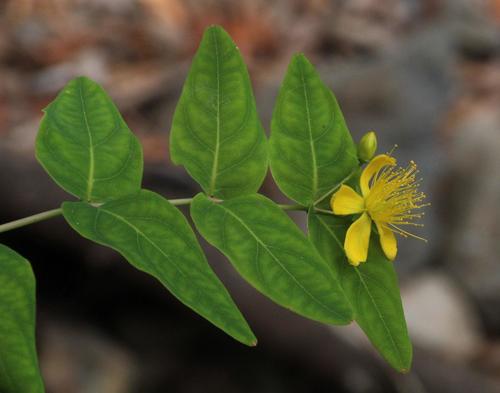
Large-Leaved Saint John's Wort (Hypericum grandifolium) is a robust, evergreen shrub native to the humid forests of Macaronesia. Standing out with its woody structure and bright, star-like yellow blossoms, this plant is a characteristic element of the Canary Islands and Madeira laurel forest understory. Its attractive foliage and striking clusters of flowers make it a visually captivating species for nature enthusiasts exploring these unique island ecosystems.
Habitat: Found in humid laurel forests (laurisilva) and damp, shaded ravines of the Canary Islands and Madeira.
This evergreen shrub grows up to 1.8 meters tall, featuring reddish-brown stems and large, opposite, ovate-lanceolate leaves that can reach 10 centimeters in length. The bright yellow flowers are about 3 to 4.5 centimeters wide, showcasing five distinct petals and a dense, explosive cluster of numerous protruding yellow stamens in the center. After flowering, it produces distinctive reddish-brown to black, berry-like seed capsules.
Category
PlantsRarity
Common
Danger
1/5 · Very low
Snaps
Be the first to snap!
The species name 'grandifolium' translates directly to 'large-leaved', highlighting its exceptionally broad foliage.
Unlike many continental Saint John's Wort species which are small herbs, this island native develops into a robust woody shrub.
When held up to the light, the leaves appear perforated due to tiny translucent glands containing essential oils.
Produces hypericin and other secondary metabolites that protect the plant's foliage from voracious herbivores.
Possesses large leaf surface areas optimized to capture minimal light filtering through dense forest canopies.
Features specialized translucent glands across its leaves that secrete aromatic essential oils to deter insect pests.
As a photoautotrophic plant, it synthesizes its own nutrients from sunlight, water, carbon dioxide, and essential soil minerals.
Bombus canariensis
Pollinates the bright yellow flowers while collecting nectar and pollen.
Chrysolina hyperici
The beetle and its larvae feed extensively on the foliage.
Laurus novocanariensis
Competes for canopy sunlight and space in the dense laurel forest understory.
No trait badges are assigned for this object yet.
No aliases listed yet.
Collections for this object will appear here as more themes are added.
Danger
1/5 · Very low
No special safety notes yet.
Start with the whole plant, then compare leaf arrangement, leaf edges, stems and any flowers or fruit. Opposite leaves grow in pairs; alternate leaves come one at a time along the stem. These details tell you far more together than a single green leaf does. Plant Identifier: upload a photo and compare the visible details.
50-180 cm
5-15 years
As a photoautotrophic plant, it synthesizes its own nutrients from sunlight, water, carbon dioxide, and essential soil minerals.
Found in humid laurel forests (laurisilva) and damp, shaded ravines of the Canary Islands and Madeira.
Zoom in to split clusters and explore where this object has been snapped.
Recent snaps will appear here as new observations are added.
Take the discovery with you
Snap it with Snappit to identify it, learn what makes it special, and add the discovery to your collection.