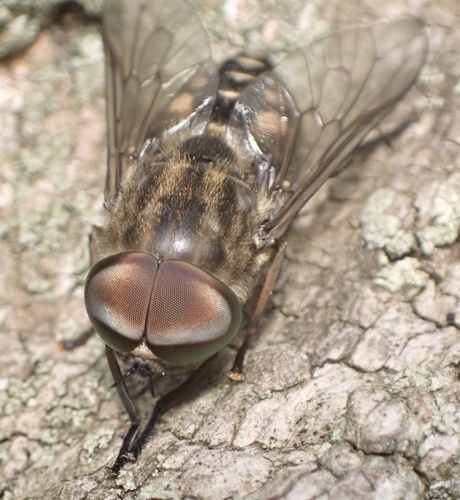


Large Marsh Horse Fly
tabanus autumnalis
The Large Marsh Horse Fly (Tabanus autumnalis) is a robust and highly active insect familiar to anyone spending summer days near European wetlands or pastures. Known for the painful bite delivered by the females, this species relies on the blood of large mammals—including livestock and occasionally humans—to properly develop its eggs. Meanwhile, the males live a much quieter life, acting as peaceful pollinators that feed exclusively on nectar and plant sap. Their ecological role is twofold: while adults are significant vectors of annoyance to grazing animals, both the adults and their predatory larvae serve as a crucial food source for birds, wasps, and amphibians. Despite their fearsome reputation, observing these flies reveals a fascinatingly complex life cycle and remarkable flight capabilities perfectly adapted to their marshy habitats.
Habitat: Commonly found in marshlands, wet meadows, damp woodlands, and nearby agricultural pastures where livestock graze.
This moderately large fly measures roughly 16 to 22 millimeters in length and features a stout, dark grey to brownish-black body. Its most distinctive visual identifier is the pattern on its abdomen, which displays a central row of pale grey triangles flanked by lighter, roundish spots. The wings are predominantly clear, lacking the dark bands or mottling seen in some related species. In life, their large compound eyes often display striking, iridescent greenish or purplish hues. Males can be distinguished from females by their holoptic eyes, which meet in the middle of the head, whereas the female’s eyes are separated by a noticeable gap.
Category
InsectsRarity
Common
Danger
1/5 · Very low
Snaps
Be the first to snap!
Only the female Large Marsh Horse Fly bites; males lack the necessary mouthparts for cutting skin and are harmless nectar-feeders.
The larvae are fierce predators that spend up to a year hunting worms and other small invertebrates in muddy soil before pupating.
Their bites are famously painful because they do not use a needle-like structure to pierce skin; instead, they use tiny serrated jaws to literally tear it open.
They are highly attracted to dark moving objects and can fly at speeds up to 30 km/h to catch up to a running horse or human.
Females possess highly specialized, scissor-like mouthparts designed to slice through thick mammalian skin to access pooling blood.
While feeding, females inject a specialized saliva that prevents the host's blood from clotting, ensuring a steady, uninterrupted meal.
Their massive compound eyes are highly sensitive to movement and dark silhouettes, allowing them to rapidly lock onto hosts from a distance.
Females require mammalian blood to produce viable eggs, while males strictly consume nectar and pollen; both sexes rely on plant sugars for daily energy.
Age differences: Larvae are entirely carnivorous, actively hunting small invertebrates, worms, and other insect larvae in muddy soil.
Bos taurus
Females frequently feed on the blood of grazing cattle, causing irritation.

Hirundo rustica
Hunted mid-air by fast-flying insectivorous birds like barn swallows.
Bembix rostrata
Preyed upon by specialized predatory wasps that capture adult horse flies.
No trait badges are assigned for this object yet.
No aliases listed yet.
Collections for this object will appear here as more themes are added.
Danger
1/5 · Very low
No special safety notes yet.
Look for six legs, antennae, three body sections and the shape of the wings. Beetles have hardened front wings; flies have just one working pair. Tiny insects may need a close view before their group is clear. Insect Identifier: upload a photo and compare the visible details.
1-2 cm
3-5 cm
0.0002-0.0005 kg
1-2 years
30 km/h
Females require mammalian blood to produce viable eggs, while males strictly consume nectar and pollen; both sexes rely on plant sugars for daily energy.
Commonly found in marshlands, wet meadows, damp woodlands, and nearby agricultural pastures where livestock graze.
Zoom in to split clusters and explore where this object has been snapped.
Recent snaps will appear here as new observations are added.
Take the discovery with you
Snap it with Snappit to identify it, learn what makes it special, and add the discovery to your collection.