

Lechuguilla
agave lechuguilla
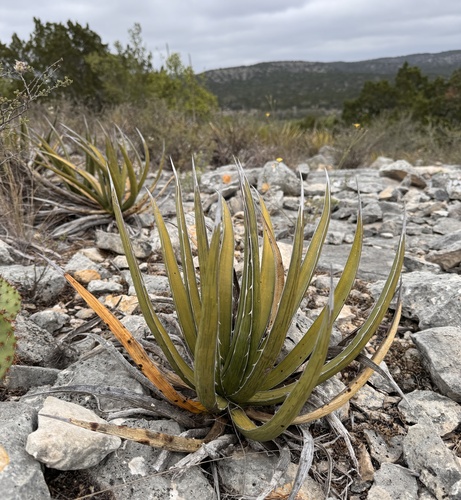
Lechuguilla (Agave lechuguilla) is a defining indicator species of the Chihuahuan Desert, painting rocky limestone slopes with its dense, spiky rosettes. Known for its tough, resilient nature, this small agave thrives in arid conditions where few other plants can survive. Its yellowish-green, upward-pointing leaves are armed with formidable spines along the margins and a dangerously sharp terminal tip, earning it a fierce reputation among desert explorers. Historically, this plant has been immensely valuable to humans. Indigenous peoples and modern industries have long harvested its strong, coarse fibers, known as istle, to make ropes, brushes, and rugs. Though highly toxic to livestock due to saponins in its leaves, it remains a critical component of the desert ecosystem, providing nourishment to specialized pollinators when its dramatic, once-in-a-lifetime flowering stalk emerges.
Habitat: Found on dry, rocky limestone hillsides and gravelly plains within Chihuahuan Desert shrublands.
Lechuguilla is characterized by a relatively small, compact rosette measuring about 30 to 50 centimeters in height. Its leaves are stiff, succulent, and curved slightly inward, boasting a light green or yellowish-green hue often marked with dark green or purplish splotches on the underside. The margins of the leaves are lined with sharp, downward-pointing teeth, culminating in an extremely sharp, dark brown or black terminal spine. When the plant reaches maturity, it produces a single, unbranched flowering stalk that skyrockets up to 4 meters high, adorned with clusters of greenish-yellow to purplish flowers.
Category
PlantsRarity
Common
Danger
1/5 · Very low
Snaps
1
Indigenous peoples have harvested its tough fibers, called istle, for over 8,000 years to weave sandals, baskets, and heavy-duty ropes.
Lechuguilla is monocarpic, meaning it grows for up to 20 years, blooms spectacularly just once, and then immediately dies.
The rigid, needle-sharp tips of its leaves are so strong that they can easily puncture heavy leather boots and off-road vehicle tires.
Utilizes Crassulacean Acid Metabolism to open its stomata only at night, dramatically reducing water loss in extreme desert heat.
Accumulates highly toxic saponins in its leaves to deter herbivores and protect its nutrient-rich core from being consumed.
Produces underground runners that grow into genetic clones, allowing the plant to spread and form dense, protective colonies.
As a photoautotroph, it manufactures its own sugars using sunlight, carbon dioxide, and water through specialized desert photosynthesis.
Leptonycteris nivalis
Feeds on the nectar of the tall flowering stalk, acting as one of the plant's primary nocturnal pollinators.
Scyphophorus acupunctatus
Larvae burrow into the succulent heart of the rosette to feed, often causing the host plant to rot and die.
Ovis canadensis nelsoni
Consumes the emerging, tender flowering stalks in spring before they can develop tough, woody fibers.
No trait badges are assigned for this object yet.
No aliases listed yet.
Collections for this object will appear here as more themes are added.
Danger
1/5 · Very low
No special safety notes yet.
The easiest way to identify Lechuguilla is to use the Snappit nature identifier app.
30-50 cm
1-10 kg
10-20 years
As a photoautotroph, it manufactures its own sugars using sunlight, carbon dioxide, and water through specialized desert photosynthesis.
Found on dry, rocky limestone hillsides and gravelly plains within Chihuahuan Desert shrublands.
Photosynthesis
Zoom in to split clusters and explore where this object has been snapped.

Texas, US
You might spot Texas Rainbow Cactus, Ocotillo, and Greater Earless Lizard.
View guide →

US
You might spot Creosote Bush, Great-Tailed Grackle, and Ocotillo.
View guide →

US
You might spot Mexican Palo Verde, Ocotillo, and Giant Reed.
View guide →

New Mexico, US
You might spot Ocotillo, Texas Mountain Laurel, and Agarita.
View guide →
Take the discovery with you
Snap it with Snappit to identify it, learn what makes it special, and add the discovery to your collection.











.jpg&width=800)



_001.jpg&width=800)




